Close readings
California Love, a full reading: the triumphant return
By Selim Rochat · 18 July 2026 · 15 min read
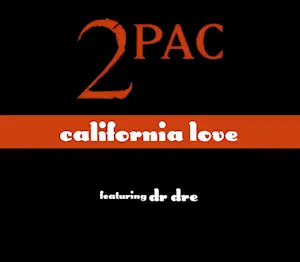
California Love is probably the Tupac Shakur track that more people have heard at least once than any other, including people who know nothing about rap. It is also, paradoxically, one of his least personal texts: only two verses, one of which is not even his, a hook sung by a funk veteran, a production signed by Dr. Dre. And yet this single, released in December 1995, is a crucial document. It marks the precise moment when Tupac stops being a famous rapper and becomes a planetary phenomenon. It opens the Death Row period, the most intense, most productive and most tragic of his life. To read it properly, then, you have to read three things at once: a text, a sound machine and a historical situation. All three tell the same story, that of a comeback staged as a triumph.
October 1995: the man walking out of prison
At the moment California Love appears, Tupac has just lived through the darkest year of his existence. In February 1995 he is convicted in a sexual abuse case he would always contest, and incarcerated at Clinton Correctional Facility in upstate New York. He serves his sentence while his third album, Me Against the World, tops the American charts: he thereby becomes the first artist to hold the number one album spot from a prison cell. That absurd situation sums up his status. No rapper had ever been so famous and so shackled at the same time.
This is where Suge Knight, the boss of Death Row Records, steps in. In the autumn of 1995 he puts up a considerable bond, in the region of 1.4 million dollars, to secure Tupac’s release pending appeal. In exchange, Tupac signs with Death Row, a three-album commitment drafted summarily and initialed in prison. On October 12, 1995, he walks out of detention, boards a private plane to Los Angeles and, according to the most consistent accounts, heads almost straight to the studio. The sessions that begin then have an intensity nobody around him has ever seen.
California Love is the first public fruit of that arrangement. Keep this context in mind throughout the reading: every second of the track is charged with the energy of a man who has just recovered his freedom and wants the whole world to know it.
Death Row in 1995: the machine doing the welcoming
To understand what this single represents, you have to measure what Death Row Records is at the end of 1995. The label founded by Suge Knight and Dr. Dre has redefined the sound of American rap in three years: Dre’s The Chronic in 1992, Snoop Dogg’s Doggystyle in 1993, the Murder Was the Case soundtrack in 1994. G-funk, that synthesis of slow funk, round basslines, high-pitched synthesizers and menacing nonchalance, rules the radio. Death Row is at once a spectacular commercial success and a company surrounded by a reputation for very real violence.
Tupac’s arrival in that structure is an industrial event as much as an artistic one. The label gains the biggest star available on the market; Tupac gains immediate freedom, production muscle and a camp in the bicoastal war then festering between Los Angeles and New York. Making his first single a duet with Dr. Dre, the tutelary figure of the Californian sound, is transparent strategy: the point is to announce an alliance. The track functions like an official communiqué. Death Row presents its new recruit, and the recruit pledges allegiance to California.
There is an irony here that I find essential: Tupac is not Californian by origin. He was born in New York, grew up in Baltimore, and only reached the San Francisco Bay Area as a teenager. California Love is therefore, among other things, an adoption ceremony. The convert sings the adopted land with more fervor than the natives.
The foundations: Joe Cocker and Ronnie Hudson
The musical construction of the track deserves a reading as attentive as the text, because it tells a genealogy. Dr. Dre builds his instrumental on a piano figure borrowed from Woman to Woman, a Joe Cocker title released in the early 1970s. The choice is anything but casual: that piano loop had already served as the bedrock of West Coast Poplock, a classic of Californian electro-funk recorded by Ronnie Hudson in 1982, an anthem for the dancers and lowriders of Los Angeles. The hook of California Love, for its part, picks up and reworks the central formula of Hudson’s track, its proclamation that nobody celebrates the way California does.
So Dre is not merely recycling a sample: he is calling up two layers of memory at once. The soul layer of the 1970s, through Cocker, and the street-funk layer of the 1980s, through Hudson. The track presents itself as the legitimate heir of a twenty-year Californian tradition. It is an operation of musical authority: before a single word is spoken, the instrumental declares that this record belongs to a lineage.
Around that figure, Dre deploys his signature: a dry, hard-hitting drum pattern, a thick bass, dramatic synthetic strings, choral layers that give the whole thing stadium-sized breadth. The tempo is faster and more nervous than the languid G-funk of The Chronic. You can feel Dre reaching for something other than a cruising song: he is building an anthem, something that has to work in a car, in a club and at an awards ceremony. Within Tupac’s sonic universe, California Love is the most spectacular summit, precisely because it is not his universe at all, but Dre’s, placed at his disposal.
Roger Troutman: the machine voice
The third player on the track may be the most important for its sonic identity: Roger Troutman, leader of the group Zapp and undisputed master of the talkbox. The talkbox is a device that pipes the sound of a synthesizer through a tube placed in the musician’s mouth; by articulating, he modulates the sound and produces a robotic, metallic, strangely expressive voice. Troutman made the tool his signature from the late 1970s onward, with Zapp and then solo, and Zapp’s funk is one of the direct sources of G-funk: the Californian producers grew up with More Bounce to the Ounce coming out of car stereos.
Having Troutman himself sing the hook of California Love, rather than an imitator, is an explicit gesture of filiation. West Coast rap does not just cite its ancestors: it invites them onto the record. Troutman opens the track by welcoming the listener into a West portrayed as untamed and lawless, carries the hook, runs through a roll call of cities, relaunches the verses, and closes the title with a long display of virtuosity in which the synthetic voice seems to improvise like a solo instrument.
The effect is double. First a party effect: that robotic voice is instantly joyful, danceable, tied to years of funk nights. Then a time effect: it links 1995 to 1980, rap to funk, Tupac’s generation to his parents’. Troutman’s machine voice is in reality the voice of memory. It is what turns a rap single into an intergenerational anthem. His violent death in 1999 would retrospectively give the performance a melancholy tint, but in 1995 it is pure celebration.
Dre’s verse: the master of ceremonies
Dr. Dre takes the first verse, and that ordering is meaningful: the host speaks first. His verse works like a welcome address. Dre presents himself as an infallible professional, a veteran who has dominated his craft for years, able to supply effortlessly what the public expects. He claims a kind of unhurried perfection, casts himself as the man whose every production lands, and reminds us that his legitimacy comes from longevity: he is not discovering California, he is one of its sonic architects.
The verse then lays out a landscape: the city, the night, parties that never stop, women, rivalries that can flare at any moment. It is worth noting that Dre’s picture is not naive. The California he describes is a place where people celebrate but also stay on their guard, where festivity and danger share the same street. That quiet tension is what keeps the track from being a mere postcard. The West is presented as a territory of pleasure that demands savoir-vivre in the literal sense: knowing how to live there, knowing how to survive there.
Rhythmically, Dre raps with an almost demonstrative calm. His delivery is measured, articulate, authoritative without aggression. That calm prepares, by contrast, the explosion to come. The whole verse is built like a stage being set before the guest of honor arrives.
Tupac’s verse: the survivor’s energy
When Tupac enters, the temperature of the track changes instantly. His voice is higher, more urgent, more rasping; he seems to bite into every syllable. And his opening move is one of the most effective autobiographical gestures of his career: he introduces himself from the first breath as a man just released on bail, barely out of detention, who had spent his time inside longing for California. In a few seconds he turns a courtroom news item into personal legend. The listener of 1995 knows perfectly well where he has come from; Tupac knows they know, and he uses it as the launch pad of the verse.
What follows unrolls a celebration in motion. Tupac describes himself arriving at the party, greeting the city, calling the women onto the floor, brandishing his new label like a banner. He casts himself as the herald of the West Coast, runs through the places, summons the image of an entire state in mid-celebration, from the neighborhoods of Los Angeles to the San Francisco Bay. The verse works by accumulation: images of dancing, heat, crowds and territorial pride pile up without pausing for breath.
What strikes me on reading it is the verse’s function more than its content. Taken line by line, Tupac says nothing complex: he is partying, he is free, he is Californian by adoption, he is proud of his camp. But the performance turns that simple material into an existential declaration. The man rapping here has spent months locked up, survived a shooting a year earlier, come through a year of trials and public humiliation. His exuberance is not lightness: it is payback. The party is his victory communiqué. Where Hit ‘Em Up, six months later, would turn survival into threat, California Love turns it into jubilation. It is the same energy, aimed at the light.
The hook: a geography of belonging
The hook, carried by Troutman, proclaims in substance that California holds the secret of celebration, and the bridge runs through cities the track salutes one by one. That roll call of cities is an old device of funk and party rap: naming the places gets the local crowds on their feet, manufactures belonging. But in the context of 1995, the geographical gesture takes on an extra meaning.
Because the map California Love draws is the map of a camp. At the height of the rising rivalry between the two coasts, celebrating California by name, its cities, its neighborhoods, its way of life, is not neutral. The track contains no attack on New York, no insult, no enemy named; that is even what radically distinguishes it from the war records to come. But its regional patriotism is so massive, so triumphant, that it works as a show of force. You can dominate without striking: it is enough to throw the biggest party and show who is invited.
There is also, in this hook, a dimension of internal unification. The California of 1990s rap is fractured by gang and neighborhood rivalries. A hook that invites the whole state to celebrate together, from the southern districts of Los Angeles to Oakland, proposes a fiction of unity. A fragile fiction, obviously, but a powerful one: for the duration of the track, the West Coast exists as a single dancing body.
The video: Mad Max in the desert
The video for California Love is inseparable from the track, to the point of being an integral part of it. Directed by Hype Williams, then in the process of becoming rap’s greatest image-maker, it transposes the song into a post-apocalyptic science fiction setting directly inspired by Mad Max, and in particular by Mad Max Beyond Thunderdome. The action is dated 2095, exactly a century after the single’s release. Shot in the Californian desert, the video shows convoys of jury-rigged vehicles, costumes of leather and metal, dust storms, a circular cage with a crowd pressing around it, and both Tupac and Dre done up as warriors of a world in ruins. The actor Chris Tucker makes an appearance.
The choice is smarter than it looks. A single celebrating California called for obvious images: beaches, palm trees, lowriders, sunshine. Williams goes for the exact opposite: he films California as a devastated desert where the party goes on regardless. The video says visually what the track says musically: even in the middle of chaos, this place knows how to celebrate. One can also read into it, without stretching much, a metaphor for Tupac’s own situation: a man emerging from a hostile carceral world who turns the landscape of his survival into a playground.
A second video accompanies the remix: it opens on Tupac waking up, discovering that the desert epic was only a dream, and tips into an enormous, very real party, this one anchored in contemporary California. The diptych, the futuristic nightmare followed by the present-day celebration, closes the argument elegantly: the dystopia was a dream, the celebration is the reality.
The remix and All Eyez on Me
The track’s discographic journey has a quirk that still confuses listeners. The single version of December 1995 and the version found on the album are not identical. When All Eyez on Me appears in February 1996, it is the remix of California Love that features on it, a rereading with a slackened tempo and a darker, more rolling feel, closer to classic G-funk than to the stadium anthem. That duality deserves a reading of its own. The single version is a machine of conquest, designed for radio, clubs and television screens the world over; the remix is an indoor version, made for car listening and for slotting into the flow of the album. The double gesture shows Death Row’s professionalism at its peak: the same track adapted for two uses, public conquest and the loyalty of long-haul listeners.
Commercially, the operation is an absolute triumph. The single settles at the top of the American charts, hands Tupac his first number one, travels the world and earns the duo a Grammy nomination in the category for rap performances by a duo or group. For an artist who, eighteen months earlier, lay in a New York studio with several bullets in his body, and who six months earlier was watching his sales figures from a prison, the trajectory is properly implausible.
What to take from it
An honest reading must first measure the silences of the text. California Love contains almost nothing of the Tupac of the great social texts: no celebrated mother, no ghetto child, no meditation on death, no political anger. Some saw in it, even at the time, the price of the Death Row signature: a complex artist reduced to an anthem machine. I think that reproach partly misses its target. In the African American tradition this track descends from, the party is anything but empty entertainment: the funk of Zapp, like Hudson’s, was always music of joy wrested from hard conditions, and in that lineage, celebrating is an act of resistance as much as a pleasure. The silence of the text is telling in its own right: the man who mentions neither his conviction under appeal nor his enemies, when everyone is thinking of both, imposes the image he has chosen. It remains true that the track announces an imbalance: the Death Row period would give the best of Tupac in volume and efficiency, rarely in depth, and California Love is the sumptuous gateway to that ambivalent period.
California Love is a textbook case: a track whose text is thin and whose meaning is immense. Line by line, it recounts nothing but a party. Set back in its moment, it recounts a liberation, a signing, an adoption, an alliance between the biggest star in rap and the genre’s greatest producer, the transmission of a funk inheritance through Roger Troutman’s machine voice, and the entry of Californian rap into its imperial phase.
Its construction is perfectly logical. Troutman opens and embodies memory; Dre unrolls the first verse and embodies the institution; Tupac erupts in the second and embodies the event. The hook unifies, the roll call of cities territorializes, the video mythologizes, the remix perpetuates. Every element of the apparatus fulfills a precise function, and that precision is what explains the title’s longevity: thirty years on, it still works, in stadiums, films and commercials, as a sonic shorthand for the whole of California.
Within Tupac’s body of work, finally, the track occupies a pivotal and poignant place. It is the summit of his public joy. Between the release from prison in October 1995 and the Las Vegas shooting of September 1996, only eleven months would pass. California Love is the sound of those eleven months beginning: a man restored to freedom, convinced he has won, singing the land that took him in with the fervor of the convert. You can listen to it as a simple party anthem. You can also listen to it the way I now do: the brightest moment of a story whose ending everyone knows, and which shines all the brighter for it.
#lecture#death row#dr dre