Close readings
Life Goes On, a full reading: the elegy in the middle of the party
By Selim Rochat · 18 July 2026 · 15 min read
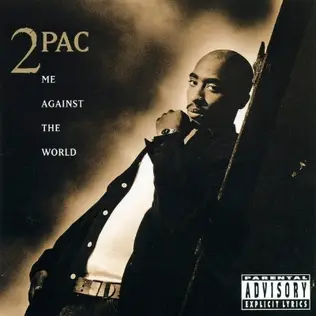
There is a strange moment, halfway through the first disc of All Eyez on Me, when the party stops. For nine tracks Tupac has been celebrating his recovered freedom with an almost insolent energy: the cars, the women, the enemies defied, the Death Row money. Then Life Goes On arrives, and everything slows down. The bass softens, a sung melody settles in, and the man who was strutting one track earlier begins to count his dead. The song runs a little over five minutes and works as a complete funeral oration, with its named dead, its liturgy, its consolation and, at its center, a scene few popular songs have dared: the narrator plans his own funeral. Let’s read this text from beginning to end.
The context: February 1996, the album of freedom
Life Goes On appears on All Eyez on Me, released on February 13, 1996 on Death Row Records, tenth track of the first of the two discs. Recall the situation. In October 1995, Tupac walked out of Clinton Correctional Facility in upstate New York, where he had been serving his sentence since February. Suge Knight, the boss of Death Row, had posted his bail in exchange for a three-album contract. Tupac went almost straight to the studio and recorded at a speed that has remained legendary: the bulk of the double album was put to tape in a few weeks at the Can-Am studios in Tarzana, California. All Eyez on Me would be the first double album of original material in the history of rap, twenty-seven tracks, a monument of excess.
And it is a party record. Where Me Against the World, the previous album, was introspective, grief-stricken, haunted, All Eyez on Me celebrates. Tupac plays the free man on it, the triumphant outlaw, the Death Row soldier. The confessor of 1995 becomes the gladiator of 1996, and that sweeping account forgets the exceptions, chief among them Life Goes On. In the middle of the triumph, Tupac carves out a funeral chamber. To place an elegy between tracks of bravado is to admit that bravado has a hinterland, and that this hinterland is a graveyard. The contrast is the song’s first meaning.
One biographical detail feeds the entire text. At twenty-four, Tupac had already buried several people close to him. Kato, a cousin by marriage tied to the Thug Life circle, was shot dead in 1994; he was already named in So Many Tears, the other great elegy in the catalogue. Mental, another friend from the same circle, died as well. Both names return in Life Goes On, spoken in full in the closing dedication. The song does not invent a fictional grief: it takes inventory of real graves.
The title: a formula of consolation turned inside out
Let’s pause first on the title, which does a good share of the work on its own. Life goes on: it is the phrase people say to the bereaved when they no longer know what to say, the ready-made formula of condolence, halfway between consolation and capitulation. It means something gentle, you are allowed to keep living, and something cruel at the same time, the world will not stop for your grief.
Tupac takes this worn-out formula and makes it work in both directions at once. Within the song, the life that goes on is first a bitter observation: friends die and the streets stay the same, the dealing resumes, the parties resume, nobody suspends anything. But it is also an instruction the narrator gives himself: keep going, hold on, move forward even as the list of the absent grows longer. And it is finally a message addressed to the dead themselves, since part of the text speaks to them directly. The banality of the title is therefore a false banality: it works the way inscriptions on headstones work, simple words, almost poor ones, loaded with everything they fail to say.
First verse: the census of graves
The first verse opens on a question of counting: how many have fallen, how many friends lost, at what pace. Tupac does not begin with a scene but with an accounting, and that gesture is already a thesis. When the dead can be tallied, death has become statistical, which is to say ordinary. The verse then unfolds the landscape readers of this site know well: the young men of poor neighborhoods caught between prison and the cemetery, the burials following one after another, the mothers in black, the childhood promises shrunk until they fit inside a brief news item.
Two movements deserve attention. The first: Tupac voices the wish, in the conditional, that he would change the world if the power were his, and observes at once that it is not. That conditional matters: the song promises no revolution, preaches nothing, it records a powerlessness. The social anger is present but exhausted, reduced to a sigh. The second movement: the narrator includes himself in the census. He does not describe himself as an observer of the dead but as a candidate, someone whose place in the same ground is reserved, and who knows it. From the first verse on, the elegy for the others already contains the elegy for the self. That was the secret structure of So Many Tears; Life Goes On takes it up and will push it much further.
A word of vocabulary, for the uninitiated. When Tupac speaks of his life as a thug, you have to hear the meaning he gave the word: not the hoodlum of the lazy translation, but the survivor of the abandoned neighborhoods. In this verse, the thug condition is not claimed as a glory but described as a fate with a short life expectancy, a profession from which no one retires.
The hook: singing to stay upright
The hook is sung, and that simple fact changes the nature of the track. Tupac the rapper can do everything; Tupac the singer can do only one thing, and he does it here: carry a simple melody with an imperfect, slightly veiled voice, doubled by backing vocals that wrap around it. The hook takes the title’s formula and turns it toward the departed, in a tone that is neither lamentation nor anthem but something in between, a funeral lullaby. You can hear in it the time passing over the graves, the grief wearing down without disappearing.
Note what this hook does not do. It does not cry for vengeance, unlike so many mourning tracks in gangsta rap that immediately convert loss into a promise of retaliation. Nor does it console through religion, though heaven came easily to Tupac. It observes, it rocks, it repeats. Repetition is the central figure here: as in wakes where the same sentences are said again because new sentences would be indecent, the hook returns unchanged, and its very return mimics the song’s subject, that time which keeps flowing over the absent.
Second verse: the man who plans his own funeral
Then comes the second verse, and with it the scene that made the song’s posterity. Tupac begins with a candid admission: to claim he never thinks about his own death would, he concedes, be a lie. The gesture disarms in advance any suspicion of posturing; what follows is a confidence. He thinks about his death so often, so precisely, that he has settled its staging.
Instructions follow. The narrator describes how he wants to be laid in the ground: a smile left on the dead man’s face, money placed on the body, like a gambler leaving the table without having lost. He asks that the ceremony be not a burial but a celebration, with drink, with smoke, with music, with women, his friends gathered around him one last time. He also touches, more darkly, on the wish that his death not go unanswered, that clause of retaliation which reminds us the funeral feast remains a feast of soldiers. All of it is delivered in the future tense and the imperative, in the practical tone of an organizer, not of a fantasy.
Let’s stop here, because this passage is one of the most singular in the entire body of work. Literature knows the poetic testament, from Villon to the Romantics: the poet bequeaths, distributes, stages himself dying. But Tupac bequeaths no possessions; he choreographs a ceremony, a spectator at his own wake correcting the details the way a director corrects a rehearsal. The reversal is complete: instead of undergoing his death, he produces it. In a world where young men die without notice, deciding the form of one’s funeral is the last sovereignty available, and the verse exercises that sovereignty with a kind of stubborn cheerfulness that may be the most poignant thing in the song. The commissioned party is not a denial of grief. It is a gift made in advance to the survivors: don’t weep, the bill has already been settled.
This obsession was not an isolated literary motif: Tupac spoke about his death in interviews, regularly, with the same calm precision. The verse transcribes a daily cohabitation with the idea of the end, an idea that moved in after the shooting of November 1994 and never left.
Third verse: news for the dead
The third verse changes its address, and it is the most delicate rhetorical gesture in the text. Tupac no longer speaks about his dead, he speaks to them. The verse turns toward a departed friend, addressed familiarly, treated as a living interlocutor, and it takes the humblest form there is: giving news. The narrator tells the dead man what has happened since he left, what has become of the circle, who is holding on, who has buckled, what the street has done with each of them. He evokes the ritual of liquor poured on the ground in memory of the absent, and he closes on a promise of reunion, asking his friend to hold him a spot, trusting they will see each other on the other side.
Addressing the dead is as old as elegy itself, but its use here has one precise consequence: it abolishes the very border the song was supposed to mourn. If the dead can be given news, they are not entirely gone; if a place must be kept for the living, the living are already half over there. The verse installs a continuity between the world of the survivors and the world of the fallen, a single territory with two districts, and death within it is no longer a rupture but a change of address. Life goes on, yes, but in both directions across the border.
The final dedication, spoken, closes the song by naming the dead, Kato and Mental first among them. This almost administrative moment, a list of names laid over the music, performs the oldest function of the funeral song: making the names last longer than the bodies. On a double album conceived as a monument to his own glory, Tupac here engraves a monument to others.
The Johnny J softness: producing a lullaby in the middle of the party
Now we have to talk about the music, because Life Goes On is as much a production achievement as a writing achievement. The track was produced by Johnny J, born Johnny Lee Jackson, who was with Daz Dillinger and DJ Quik one of the principal craftsmen of All Eyez on Me. Johnny J had already worked with Tupac on Me Against the World, and their understanding in the studio remained famous: witnesses to the Can-Am sessions describe a rapper who wrote in minutes and a producer able to keep that pace without sacrificing refinement.
On Life Goes On, his choice is to cut against the grain. Where the album favors the heavy bass and aggressive synthesizers of Death Row’s G-funk, Johnny J builds a plush bed of sound: slowed tempo, a round and almost caressing bassline, muffled keyboards, discreet guitar, backing vocals rising behind the hook like a church choir mixed at a distance. The drums strike gently, without snapping, as if out of respect for the subject. The whole evokes less the rap of 1996 than the mourning soul of the seventies, those records Black American families actually played at funerals. It is a craftsman’s choice: rather than illustrating death through darkness, illustrate grief through tenderness. Taken on its own, the production is beautiful; in its place in the sequencing, between the party tracks, it is devastating, like a silent room in a noisy house.
And there is the voice, which deserves precise description. Tupac modulates here between rapping and singing without ever choosing, with that rounded diction he reserves for intimate texts. No aggression, none of those hammered accents that are his signature elsewhere on the album. He raps the way one speaks at a bedside, and when he sings, the very imperfection of the singing, slightly unstable, serves as proof: a professional singer would have made it pretty, he makes it true.
Mourning in nineties rap: a tradition of wakes
Life Goes On was not born alone. American rap in the nineties produced an entire corpus of mourning songs, a genuine genre with its codes and its masterpieces. Dead Homiez by Ice Cube, as early as 1990, described a neighborhood funeral with the sobriety of a news report. They Reminisce Over You by Pete Rock and CL Smooth, in 1992, turned the death of a friend into a melancholy fanfare. The same year, 1996, would see the triumph of Tha Crossroads by Bone Thugs-N-Harmony, a sung prayer for the departed and an immense commercial success. And Tupac himself had already made his own contribution with the libation track on the Thug Life album in 1994, then with So Many Tears.
This flowering answered a demographic reality: at the turn of the nineties, at the peak of the homicide epidemic tied to the crack economy, homicide had become the leading cause of death for young Black American men. An entire generation of artists grew up burying their classmates, and the music did what the institutions did not: it supplied the rites. The rap mourning song fulfills exactly the functions of the traditional funeral chant, naming the dead, gathering the survivors, transforming loss into transmissible memory. The libation poured on the ground, a gesture that returns in Life Goes On, is its sacrament.
Within this corpus, the place of Tupac’s song is singular. Most rap elegies weep for others; Life Goes On is, to my knowledge, the only great elegy of the genre in which the narrator devotes an entire verse to his own funeral, inserting his death to come into the list of deaths already arrived. That torsion, sketched in So Many Tears, reaches its finished form here, and it explains what happened next.
After September 1996: the song become mirror
Because there is a before and an after. On September 7, 1996, seven months after the album’s release, Tupac was sprayed with gunfire in a car in Las Vegas; he died on the 13th. And Life Goes On instantly changed nature. What had been a meditation became a prophecy; what had been a verse became a testament. American radio played the track massively in the weeks that followed, fan vigils played it on a loop, and listeners discovered, stunned, that they had owned since February a record on which the dead man had described his funeral wishes. The tributes that followed naturally gave it a central place: Tupac had literally left the instructions.
This posthumous rereading feeds the legend, and it has to be handled with care. The song became one of the centerpiece exhibits in the case that lovers of mystery have been building for three decades: how could a man have described his end with such precision unless he knew something. I have dismantled elsewhere what those speculations are worth. The sober answer is more moving than the theory: Tupac predicted nothing, he described a statistical risk he knew by heart, that of a famous young Black man, armed, surrounded by enemies, in the America of 1996. The prophecy is unsettling only to those who had not been listening. He had been listening to himself very closely.
What remains is that the posthumous resonance made the song something other than an album track: a rite ready for use. Since 1996, Life Goes On has become actual funeral music in the United States, played at real ceremonies for real dead, particularly in the neighborhoods the text speaks of. Few songs carry out their program this way: a funeral oration written in a studio that ends up delivered over graves. The song mourned the dead, prepared its author’s death, and now consoles the living whom Tupac never knew. Life goes on, indeed, and the song goes on with it.
What Life Goes On really says
Let’s sum up the journey. A first verse that takes the census of the graves and reserves a place in them for the narrator. A hook that rocks instead of crying out. A second verse in which the man stages his own funeral and orders it joyful. A third that brings news to the dead and makes an appointment with them. A dedication that engraves the names, Kato, Mental, the others. And around all of it, the gentlest production on its author’s most triumphant album, a lullaby set down in the middle of a fireworks display.
What the song says, in the end, fits in one sentence: in a world where death is ordinary, mourning must learn to live with the party, and the party with mourning. Tupac does not choose between weeping and celebrating; he makes the funeral a party and the party a haunted place, and that assumed confusion is his answer to a situation that offered no better option. So Many Tears was the lament of a man discovering himself keeping vigil over his own body; Life Goes On, a year and a half later, is the next stage: the man has finished mourning himself; he is organizing the reception. Between the two lies the whole trajectory of Tupac Shakur, and perhaps the whole difference between the fear of dying and the acceptance of dying. You can find that acceptance serene or terrifying. I believe it is both, and that this is why the song, thirty years later, still does what the great elegies do: it consoles, and it does not soothe.
#lecture#all eyez on me#deuil