Close readings
All Eyez on Me, a full reading: the gaze as an open-air prison
By Selim Rochat · 9 July 2026 · 24 min read
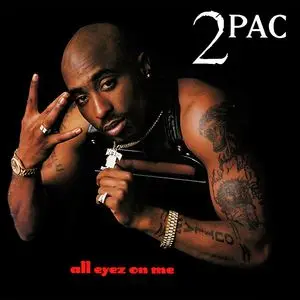
All Eyez on Me is one of the most revealing songs of Tupac’s Death Row period. It is not just a track about fame. It is a song about surveillance, paranoia, money, status, prison, the police gaze, the media gaze, the sexual gaze and the gaze of enemies. The title says it all: every eye is on him. But those eyes do not only mean admiration. They also mean suspicion, envy, fear, control and pursuit.
To understand the song, you have to place Tupac at this precise moment. He walks out of prison in October 1995. He signs with Death Row Records, the California label run by Suge Knight, already wrapped in an image of power, violence, luxury and gangsta rap. Tupac is no longer just the introspective rapper of Me Against the World. He becomes a central figure of American rap, watched by the media, by the police, by his enemies, by his fans, by the music industry and by his own inner circle. The song gives that situation a shape: he is the man everyone is watching.
The opening: never alone
The intro starts with names: Big Syke, Nook, Hank, Bogart, Big Sur. Tupac summons his entourage. He does not step forward alone. He arrives flanked by a crew, a circle, a clan. That matters, because the song is about a man who is exposed, yet shielded by a street community. In Tupac’s world, being watched by everyone means you cannot travel unaccompanied. Visibility creates danger; the group works as a shield.
The opening address sets up a coded familiarity: you already know how this goes. He does not explain anything yet. He assumes that those inside the circle understand the mechanics: walking into a club, being recognized, being watched, being wanted, being tested, being threatened. The song starts from that social experience of the gaze. When Tupac enters a room, nothing is neutral. Everyone is measuring, desiring, envying, fearing, or setting something up.
The title is repeated like a statement of fact and like a motto. It is not only a complaint. It is also a claim. Tupac knows he is being watched and converts that gaze into power. Where surveillance could crush him, he turns it into a show. What he is saying, in essence, is this: since all of you are watching, watch me grow larger than your control.
The first verse: envy, loyalty, the future
The first verse opens with a warning: people have it wrong, they no longer know where to place their trust. The world it describes is one of confusion and suspicion. There are imitators, jealous men, rivals who want his style, his sound, his position. Player-hating names the resentment aimed at the one who wins, who draws attention, who succeeds. Right away, Tupac frames fame as a source of envy.
He accuses certain rappers of trying to sound like him. That accusation is central to his entire Death Row period. Tupac is not only fighting over money or territory. He is fighting for the authenticity of his voice. His style, his energy, his pain, his persona are treated as goods that others try to copy. In rap, being imitated can be flattering. Here, Tupac experiences it as a threat and a theft.
When he says some men claim to be ready for the funk, he is not talking about funk music in the strict sense. In this context, funk means conflict, tension, confrontation. His answer is that these people have no idea what that actually involves; the fakers, he warns, are headed for the lowest floors of hell. The wording is excessive, but it defines the song: whoever plays at war without knowing its rules will be destroyed.
The question of who is still down matters. Being down means being loyal, still standing with him, staying faithful through prison, the scandals, the danger, Death Row, the feuds. Tupac is speaking to those who claim to love him or ride with him. After prison, the real question becomes: who is still here? Who did not switch sides? Who did not profit from his absence?
When he suggests that the devils will come to regret ever setting him loose, he turns his release from prison into a mistake committed by the system. The devils can mean the police, the judges, the enemies, the racists, the authorities, or more broadly every force that wanted him caged. His freedom is presented as a threat: they should have kept him locked away, because outside he comes back stronger.
The image of a convoy of companions every time he goes out underlines the collective dimension of his power. He does not roll alone. He arrives in formation. Rolling, here, also means moving into action, confronting, representing your side. The car is a central motif: going out, crossing the city, passing in front of enemies, occupying public space with force. The street is a moving theater. The passage about striking adversaries while in motion belongs to the violent idiom of gangsta rap: the evocation of the drive-by, symbolic or real. It has to be heard as part of the persona. Tupac builds the image of a man who does not settle for being watched; he acts, retaliates, hits while moving.
He then declares that he intends to carry himself as a boss player for as long as he breathes. The expression joins two levels. The boss is the one who commands, who owns, who no longer submits. The player is the one who masters the social, sexual and economic game. Tupac does not merely want to survive. He wants to dominate the rules of the game. Yet that dominance stays unstable, because even when he is high, even in intoxication or euphoria, whoever moves against him will be dealt with later. He does not forget. The memory of the threat remains.
One of the most interesting lines in the verse flips the title around: every eye is on him, but he himself carries the future in his own gaze. He is not only the object of the look; he is also a seer. He sees what is coming, the money, the cars, the rings, the risks, the possible death. That idea gives the song an almost prophetic dimension. Tupac is watched by everyone, but he sees further than any of them.
He then states his appetite for cash and material things: a Mercedes, flashy rings, the classic emblems of 1990s rap luxury. This has to be read against the backdrop of poverty and prison. Money is not mere vanity. It is proof of escape, proof of revenge, proof that the poor kid can force the world to acknowledge him. But with Tupac, that success is always bound to danger. Jewelry attracts women, envious men, police, thieves, eyes.
Women chase him like a dream. Here again, the misogyny of the gangsta register is plain: women appear mostly as desire, reward, risk, instruments of prestige. But the line also does celebrity work: Tupac presents himself as an object of fantasy. He is the one people want to touch, possess, follow. He is a living dream for the public and for the women he describes.
The comparison with the addict who fades from view is darker. The addict is a figure of disappearance, instability, lack. Tupac says he can vanish that way. It can mean that he slips loose, that he escapes control, but also that his own life is unstable. Flamboyant celebrity sits right next to the junkie’s erasure. The song blends glamour and decay.
He asserts that his main ambition was always to get paid on a large scale: to earn big, to reach real economic power. Not small survival money, but visible wealth. The game is then compared to a razor’s edge. The image is precise: the game is sharp, thin, dangerous, capable of cutting whoever handles it clumsily. Success demands an almost criminal precision.
The chain he draws, money bringing women and women bringing deceit, expresses the song’s sexual and social distrust. Tupac lays out a sequence: money, desire, lies, jealousy, death. Money does not liberate; it attracts false relationships. Women are unjustly reduced here to a source of betrayal, but within the paranoid logic of the text they belong to the forces that surround and threaten the rich man. The next line adds that jealousy kills. One man turns envious and people die. The passage tips material success over into violence. Wealth is never stable. It breeds rivalry, envy, weapons, retaliation. Visibility attracts death.
The image of the paydays, the first and the fifteenth of the month, points to the wage checks and welfare payments that land at the start and the middle of each month. Tupac casts himself as a regular source, as expected money, as support. People depend on him the way they depend on a scheduled deposit. It is a mark of power and a burden at once. Being the man others count on for money adds yet more pressure.
He then says his enemies can hold him for a moment but will never own him. That points to prison, arrests, indictments, attempts at capture. Tupac has been locked up, but he insists the system cannot possess him for good. His freedom is not only legal; it is symbolic. Even captured, he thinks of himself as beyond reach.
The end of the verse returns to lowriders, ski masks and Thug Life shouted out loud. Lowriders are the low-slung cars tied to certain urban cultures and to West Coast aesthetics. The ski masks conjure robbery, violence, criminal anonymity. Thug Life is Tupac’s central slogan: a street identity, a personal brand, a cry of resistance and a formula for the lives of criminalized youth all at once. So the verse closes on a collective image: men in a car, masked, shouting an allegiance.
The hook repeats that Tupac means to remain a thug for the rest of his days, and to keep moving like a boss player even when intoxicated. That repetition is more than a slogan. It fixes the song’s contradiction. Thug names the street man, violent, criminalized, produced by a brutal world. Boss player names the man who has taken control of the game, who wins, who seduces, who owns. Tupac wants to be both at once: the product of the street and the master of the game.
Big Syke: the view from the periphery
Big Syke comes in next. Big Syke was one of Tupac’s close associates, a member of Thug Life and part of his musical circle. His presence gives the song a second point of view, less iconic but very coherent. Where Tupac speaks from the center of the media storm, Big Syke speaks from the peripheral world of the street, of money, of dread and of daily survival.
His verse opens with a wide statement: the world holds so much trouble that nobody can truly feel Tupac’s pain. That line makes Tupac an exposed yet solitary figure. Everyone watches him, but no one really understands the pain that comes with that visibility. The song separates seeing from understanding. All eyes are on him, but those eyes do not necessarily see straight.
Big Syke says the world shifts every day, that time moves fast. Unlike the hook of Changes, which insists on the absence of structural change, here change means speed, pressure, instability. The world moves too quickly for those trying to survive. Relationships, loyalties, money needs, threats all advance without pause.
The line about his woman asking for more money introduces domestic pressure. Even inside street life or rap life there are daily demands: feeding, paying, satisfying, holding a relationship together. His wondering how long she will stay reveals emotional insecurity. Not enough money weakens love. Poverty, or economic instability, wears a couple down.
He describes himself caught between his woman, his weapon and his money. That triad sums up his world: affection, violence, economics. The street imposes its priorities. Love exists, but it is wedged between armed protection and the need to earn.
The triple beam is a scale used in the drug trade to weigh product. The smokers are the customers. Big Syke sketches an environment of dealing, moving, selling, consuming. This is not a romantic backdrop but a concrete economy where survival runs through drugs, clients, escape routes and constant alertness.
He says he is lost in a country without a map, living a life that looks flawless from the outside. The contradiction is plain: the surface can seem mastered while the inside is adrift. The image of the crime boss and the smuggling reinforces the criminal persona, but it does not erase the disorientation. Crime provides an economic structure, not necessarily a meaning.
When he mentions mediocre men with too much nerve, he is voicing contempt for weak competitors, for the jealous, for men who talk without substance. His car pulls away from the curb: another image of motion. In this song, standing still is dangerous. You have to roll, leave, flee, display, circulate.
Nervousness and carelessness push him to carry a TEC, an automatic or semi-automatic weapon tied to the criminal imagination. Carrying a gun appears as a response to dread. You do not carry a weapon only because you plan to attack; you carry one because you trust nothing. Paranoia becomes equipment.
Big Syke then brings up the Moët and the paychecks. Champagne and money appear side by side. As with Tupac, success is made of luxury and menace together. The party and the payday are reasons to keep going, but they are ringed by parasites, trigger fingers, small vermin. The image of leeches and fleas suggests that success attracts creatures who want to feed, bite, steal, cling.
He claims to run his business without emotion. It is an ethic of hardness. In this world, feeling can be weakness. Devotion goes to the hustle, the management, the movement. The idea of continuing to glide fits the West Coast aesthetic: staying fluid despite the danger, surviving through constant motion.
Then comes a strong line: wherever you are headed, he has already been, and he came back from it alone. Experience does not only produce wisdom; it produces isolation. The man who has survived certain roads returns with fewer illusions and fewer companions.
He says he moves against the current and that people still do not know him. The central theme returns once more: being seen is not being understood. Even those who watch Big Syke or Tupac have no idea what they carry. The public gaze simplifies, judges, envies, but does not know.
The end of Big Syke’s verse dwells on money in rap. This industry is no joke. People do not know how to behave. Rap is art, business, street, competition and trap all at once. Money attracts unstable behavior. Big Syke then asks a question that is almost existential: what can he do, what can he say, is there another road? The verse’s answer is bleak: blunts, gin, gambling, hustling, repetition. He does not really see another way out.
His final movement asserts that there is no weakness in him, no fake toughness, no coward. Others cannot stand him. All eyes are on him too. So the hook lands not only on Tupac but on an entire condition: being visible, envied, suspected, threatened, watched.
The third verse: the feds are watching
Tupac’s third verse returns to a more direct paranoia. Federal agents are watching; men are plotting to bring him down. The feds are the federal authorities, the FBI, the investigators, the machinery of the state. So the gaze is no longer just that of fans or women. It is the institutional gaze. The song moves from the club to the courtroom, from the party to the stakeout.
The question of whether he will make it out alive or die gives the verse a tragic dimension. Tupac asks us to imagine the possibility. It is no abstraction: in his life, death is already close. He has been shot, jailed, surrounded by enemies, exposed in the press. Fame does not dissolve the question of death. It amplifies it.
The criminal charges and the lawyers earning fortunes come next. Justice is an expensive machine. Being accused, even when rich, means paying, defending yourself, losing time, living in suspension. The court system is also an economy. It generates fees, professions, dependencies.
Tupac tells the judge that he was raised badly and that this is why he lashes out. The line is layered. It can sound like an ironic excuse: he explains his violence through a failed upbringing, a warped environment, a deformed childhood. But it is also a social indictment. If he was raised wrong, that is not just his mother’s failure. An entire world shaped him in chaos.
He describes himself as hyperactive as a boy, cold as a teenager. The shift from hyperactivity to coldness is very powerful. The child overflows with energy; the adolescent hardens. The street, poverty, the police, prison and violence convert childhood energy into strategic coldness. Tupac reads himself as the product of a brutal maturation.
The scene with the mobile phone and the big plays called on the major stage signals his new power. In the 1990s, a mobile phone is a sign of status and command. Tupac is no longer merely in the street; he organizes, decides, calls important people. Fame has changed the scale on which he operates.
He then speaks of hundreds of bills stashed away, of contempt for the law, of passionate sex, of a life lived raw and unvarnished. These elements compose the Death Row portrait: cash, legal defiance, sex, brutality, authenticity without polish. Tupac insists that celebrity will not domesticate him.
The court cases arrive at high speed while he lives in the fast lane. The fast lane is the accelerated life: money, sex, drugs, concerts, trials, enemies, media. Hustling until morning, never stopping before the money lands: the work, legal or not, is ceaseless. Success is a rhythm of exhaustion.
He then folds the hook back into the verse almost word for word. That repetition shows the hook is not external to the story. It is its inner principle. Tupac actually lives by this formula, or at least he wants the public to hear it that way.
He says his enemies push him to the edge, then drops the roof of the car and displays what he owns. To floss means to show off, to flaunt luxury. After prison and the accusations, displaying success becomes a counterstrike. The convertible, the Benz, the rubber burned on the asphalt: all of it says he is out, visible, still winning.
The nod to Keep Ya Head Up deserves a pause. In the 1993 song, the formula is a consolation addressed to Black women and to the poor. Here it is repurposed in an aggressive context: holding your chin up while making your adversaries suffer. Consolation becomes defiance. The moment shows how, in Death Row era Tupac, formulas of moral endurance can be turned into weapons.
The criminal lifestyle is described as coming fitted with a bulletproof vest. The image is stark: this life is never lived bare. It requires protection. Even success needs armor. The vest embodies the permanent awareness of being aimed at. Once again, all eyes are on him, and some of those eyes sit behind guns.
He then urges his circle never to lose sight of the meal ticket. The meal ticket is whatever lets you eat, pay, survive, get rich. Here he turns it into a discipline: no distractions, aim at the money, get wealthy, and only then enjoy. The end of the verse sums up the song’s economic philosophy: secure the money, build the fortune, then reunite and celebrate. Social bonds run through material success. Money is mandatory. Women serve to manage stress. The song’s moral hierarchy is very harsh and very male.
The outro: crosshairs
The last hook returns as a circular closing. Repetition produces an effect of destiny. This is no longer a one-off choice. It is an announced trajectory, almost a voluntary sentence. Tupac does not say he sometimes lives this way. He says he will live this way to the end.
The outro spells out the title. He asks us to pay attention to how it plays out. When he walks in somewhere, everyone reacts: the police, the women, the enemies, everyone. The song returns to the scene of the club or the public square. Entering a room is never neutral. His presence trips a social alarm.
He names the bustas, the sexualized women and the police as different but converging gazes. Bustas are the weak, the fake tough guys, the contemptible rivals. Three very different categories stare at the same man for different reasons: envy, desire, control. Tupac stands at the crossing of all those looks.
He mocks those who assume he walks around with kilos of drugs in his pockets. That line matters because it exposes the effect of criminalization. People no longer see an artist, a man, a son, a poet, a star. They see a permanent suspect. Black male wealth, especially when tied to rap and the street, is instantly imagined as drugs, crime, the next prison term.
He says they expect him to go back to prison. That refers to his post-incarceration situation. Many look at him as a man already condemned to reoffend, to fail, to be reclaimed by the system. Tupac rejects that expectation, but he knows it exists. The public gaze is prophetic: it is waiting for his fall.
Then comes the strongest image of the outro: he knows he is being held inside a rifle scope. The gaze becomes a gun sight. Being watched is no longer merely being observed; it is being targeted. Here the title finds its darkest meaning. All eyes on him also means: all crosshairs on him.
He closes with Thug Life and surveillance. He knows he is under observation. That lucidity gives the song its tragic force. Tupac does not celebrate fame naively. He knows the same gaze that makes him immense may also be preparing his destruction. The song is a festival of visibility and a confession of paranoia.
Born in a studio moment
Producer Johnny J’s testimony throws sharp light on the track. According to him, All Eyez on Me was the first song Tupac recorded after arriving at Death Row. Tupac had just come out of prison, was calling his people to the studio, and ideas were surfacing at speed. The producer recalls that the beat was not even meant to be played, that he considered it unfinished, but that Tupac found the concept instantly. That detail matters: the song does not seem to have been conceptualized at length like a theory. It was born in a moment. Tupac walks into the studio, feels that every gaze really is fixed on him, and turns the situation into a song.
That explains the track’s force. The title is not just a catchy phrase. It is Tupac’s actual state at that instant. He is fresh out of prison. He has just signed with the most notorious label in California rap. The press is watching him. The fans are waiting. The enemies are circling. The police have not forgotten him. The industry wants his comeback. The rivalry between Death Row, Bad Boy, West Coast and East Coast is turning explosive. The title captures that pressure in three words.
Poetically, the song rests on one simple, powerful idea: the gaze as an open-air prison. Tupac is free, but he is watched everywhere. He is outside, but he remains under surveillance. He is rich, but he attracts jealousy. He is famous, but fame becomes a target. He is desired, but the desire is suspect. He is admired, but admiration can curdle into hate. The prison has changed shape: it has become mediatic, police-driven, sexual and social.
The song is also a celebration of exhibition. Tupac does not try to escape the gaze. He provokes it. He walks into the club, rolls in the Benz, drops the roof, shows the rings, claims Thug Life, shouts his status. His answer to surveillance is not discretion. It is an excess of visibility. If everyone is watching, then he must become impossible to ignore.
The strategy is dangerous. The more he shows himself, the more of a target he becomes. The more he asserts his status, the more envy he draws. The more he plays the boss player, the more he needs the bulletproof vest. The song knows this, and does not stop. It chooses flamboyance over caution. That is one of the tragic traits of the 1996 Tupac: he sees the danger and accelerates anyway.
The song’s misogyny has to be named. Women appear in it mostly as sexual pursuit, deceit, sources of stress or trophies of prestige. That vision is brutal and repeated. It belongs to the track’s gangsta persona, but it should not be excused as mere scenery. It shows that the freedom celebrated here is a male freedom, built around money, sex, the car, the gun and domination.
An ego under threat
The song has none of the tenderness of Dear Mama, none of the explicit political conscience of Changes, none of the melancholy of I Ain’t Mad at Cha. It belongs instead to mythological construction. In it, Tupac manufactures the image of the man who comes home from prison knowing the whole world is waiting for him. That image is arrogant, lucid and suicidal at once. It says: look at me, but know that your gaze does not own me.
Within the economy of the album All Eyez on Me, the track works as a mission statement. The entire album stands under the sign of total visibility. Tupac is everywhere: party, war, sex, money, revenge, prison, mother, politics, paranoia, God, death. The album title does not simply mean that everyone admires Tupac. It means that Tupac lives in a condition of permanent overexposure.
All Eyez on Me is therefore a song about celebrity as a trap. The rap star is watched like a king and like a criminal. She or he is desired as a product, monitored as a suspect, imitated as a model, hunted as an enemy, consumed as a spectacle. Tupac understands the mechanism and turns it to his advantage, but he cannot switch it off.
The song is also about leaving prison without leaving control. Tupac is legally free, but the feds are watching. The lawyers keep billing. The enemies keep plotting. The women keep chasing. The police keep waiting. The fans keep observing. The media keep interpreting. Freedom presents itself as a space saturated with gazes. The outside looks like a stage where every gesture can become evidence.
The song’s troubled grandeur lies in this contradiction: Tupac complains about being watched, yet demands the gaze; he fears surveillance, yet converts surveillance into glory; he knows he is targeted, yet drops the roof of the car; he knows money attracts death, yet wants more money; he knows the criminal life requires the bulletproof vest, yet keeps claiming that life.
All Eyez on Me is not, then, a simple ego song. It is a song of ego under threat. The ego works as armor against fear. The bravado is a way of never looking vulnerable. The wealth is a defense against past poverty. The sex is proof of status. The gun is an answer to surveillance. The paranoia is almost rational.
For a reader coming to this cold, the central stake is this: Tupac has just left prison and understands that his life has become a national spectacle. He is observed by fans, media, police, enemies, women, imitators, envious rivals and the industry itself. Instead of hiding, he chooses to make that exposure a banner. He turns the gaze trained on him into a title, a hook, an album, a mythology.
The song fascinates because it lets us hear the exact instant a man makes a crown out of his overexposure. It unsettles because that crown already looks like a target. All eyes are on him. In Tupac’s logic, that is a victory. In the tragic logic of his story, it is also an omen.
#lecture#all eyez on me#célébrité