Close readings
Keep Ya Head Up, a complete reading: the anthem rap wasn't expecting
By Selim Rochat · 9 July 2026 · 25 min read
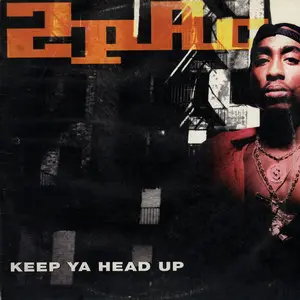
Keep Ya Head Up is one of Tupac Shakur’s most important texts, because it shows a side of him that the caricatures of his public persona systematically forget. Tupac can rap as a gangster, an armed man, a paranoid survivor, a sexual provocateur. Here he speaks to poor Black women, to single mothers, to humiliated girls, to abandoned children, to young men without fathers, to a whole community caught between poverty, racism, sexism, drugs, prison and social war. When people want to prove that this rapper, hounded by courts and columnists, was something other than a provocateur, this is the song they reach for. When they want to accuse him of incoherence instead, this is still the song they hold up, next to his most abusive records. It deserves better than that role of courtroom exhibit. It deserves to be read line by line.
Where the song comes from: 1993, a second album under pressure
Keep Ya Head Up appeared in February 1993 on Strictly 4 My…, Tupac’s second album. The context matters enormously. Tupac was leading a double public life. On one side, he had become a political target within a year: his first record had been denounced by vice-president Dan Quayle as having no place in society, and the press was painting him as the embodiment of the dangerous rapper. On the other, he came from Los Angeles in the most burning sense of the word: the city was emerging from the April 1992 riots, the days of fire that followed the acquittal of the police officers filmed beating Rodney King.
The song was produced by DJ Daryl, a Bay Area craftsman Tupac had known since his apprentice years, with R&B singer Dave Hollister on the hook. Musically it rests on two perfectly chosen borrowings: the rhythmic base and the warmth of the groove come from a sample of Zapp’s Be Alright, and the sung hook takes up the melody of O-o-h Child by the Five Stairsteps, a 1970 soul song performed by a family group from Chicago whose message fits in one promise: things are going to get easier and brighter. Tupac takes that seventies soul promise and sets it down in a much harder world: welfare, crack, absent fathers, rape, abortion, war, prison, despair. Released as a single on October 28, 1993 on Interscope, the track climbed to number twelve on the Billboard Hot 100, a commercial peak for Tupac at that date.
But before being a hit, it is a dedication, two in fact. The spoken introduction dedicates the song to his godson Elijah and to a little girl named Corin, generally identified as the daughter of Salt, of Salt-N-Pepa, whom Tupac knew through Treach of Naughty by Nature. That dedication is essential: the song does not open with an adult rapper’s pose but with two children. Tupac is writing from the future he wants to spare them. And the video, for its part, opens on a title card in memory of a dead girl.
Latasha Harlins, the fifteen-year-old the courts counted for nothing
The case has to be told, because the song does not exist without it. On March 16, 1991, in Los Angeles, thirteen days after the beating of Rodney King, a Black teenager named Latasha Harlins, fifteen years old, walked into a grocery store in the south of the city, the Empire Liquor Market, to buy a small bottle of orange juice worth less than two dollars. The owner, Soon Ja Du, a Korean-American shopkeeper, accused her of trying to steal the bottle. Witnesses would say the girl was holding the money in her hand. A scuffle broke out, the shopkeeper grabbed the teenager, the girl fought back and struck her, then put the bottle down and turned to leave. The store’s security camera recorded what followed: Soon Ja Du picked up a revolver and shot Latasha Harlins in the back of the head. She died on the spot.
The trial took place in the autumn of 1991. The jury found Soon Ja Du guilty of voluntary manslaughter, a verdict that could have meant years in prison. Judge Joyce Karlin decided otherwise: a suspended sentence, five years’ probation, four hundred hours of community service, a five-hundred-dollar fine. Not one day behind bars for shooting a teenager from behind, on camera. That ruling, handed down a few months before the acquittal of the officers in the Rodney King case, was experienced by Black Los Angeles as an arithmetic demonstration of what a Black girl’s life was worth in the eyes of the institution. Historians of the 1992 riots systematically cite the Harlins case among their deep causes.
That is what the dedication of Keep Ya Head Up carries. Tupac does not recount the case in the text. He does something stranger and stronger: he places his whole song, a song about the dignity and survival of Black women, under the name of a girl to whom all of that was denied. By opening the song’s visual world on Latasha Harlins, he ties the defense of Black women to racial violence, to the vulnerability of young girls, and to the collective memory of Los Angeles. The title itself, that injunction to hold your head high, is addressed first to those with every reason to lower it.
First verse: the praise that moves the proverb
The song opens with a famous formula, borrowed from an old African-American folk saying about fruit, which holds, roughly, that the darker the fruit, the sweeter what it yields. But Tupac does not stop where the saying usually stops, at the eroticization of dark skin. He extends it his own way: the darker the flesh, the deeper the roots run. That displacement is crucial. He is not merely saying that dark-skinned Black women are desirable. He is saying their darkness is memory, depth, inheritance, ancientness. Skin color, devalued by racism and by colorism, that prejudice inside Black communities which prizes lighter skin and disparages darker skin, becomes a sign of rootedness. In two lines, he tells the girls whom the social gaze pushes to the bottom of the aesthetic ladder that they are precisely the most precious.
Then he greets his sisters on welfare, the American public-assistance rolls. In the America of the 1980s and 1990s, poor Black mothers were stigmatized in political and media discourse: painted as irresponsible, dependent, culpable, parasites on the system. Tupac inverts that gaze. He does not accuse them. He tells them he cares about them even if nobody else does. The song thus begins with an act of social recognition. And he acknowledges in the same breath that these women are demeaned by the Black men of the neighborhood too: when they come around the block, men mock, judge, sexualize, humiliate. Tupac is not content to denounce white racism or the state. He also criticizes how the men of his own community treat their women. It is one of the song’s strengths: the external critique and the internal critique advance together.
Then comes the consolation, and it is not a soft one. He asks the woman in tears to dry her eyes and to give up nothing. To keep your head up, literally, is to keep your dignity when the world wants to bend you: the raised head is not gratuitous pride, it is bodily resistance. And he adds a piece of advice with nothing naive about it: pardon what was done, but keep the memory of it. Forgiving can free you from hatred; forgetting leaves you open to the repetition of the abuse. The song proposes an ethics of survival: refuse to be destroyed by resentment, without erasing what men and the world have done.
He then addresses the woman whose man keeps telling her she is worthless, and asks her not to believe him: if that man cannot learn to love her, she should leave. The sentence breaks with rap’s virilist imagination, where the woman is ordered to stay loyal. Here Tupac tells her that walking away can be right, that she does not need him, that a man who cannot love does not deserve to be kept. A rare position in mainstream male rap of the early 1990s: he does not love women in the abstract, he tells them to leave destructive men. And he makes clear he is not trying to butter them up. It is a diagnosis, not an interested compliment.
The next sequence goes after irresponsible fathers: what makes him miserable, he says, is watching men make babies and then leave a young mother to play both parents at once. Paternal desertion is a central theme for Tupac, who grew up inside the painful absence of his own biological father; it returns in Dear Mama, in Papa’z Song, in every text where the Black family appears fractured by poverty, prison and absent men.
Then the verse turns theoretical, and this is the most famous passage in the text. Tupac points out that every man comes from a woman, takes his name from a woman, and learns from a woman his game, that slang word for style, social intelligence, a way of carrying yourself. Men therefore owe women their existence, their identity, their very know-how. Misogyny is presented as a fundamental ingratitude. And the string of questions that follows is one of the summits of the song: why do we take from our women, why do we rape our women, do we hate our women? Measure the radicality of those lines in a male rap record from 1993. Tupac is not talking about vague respect. He names rape. He names sexual violence. He names the hatred of women inside the community itself, and he anticipates what would later be called rape culture: the ensemble of behaviors and discourses that normalize, minimize or excuse sexual violence. He is not building an academic theory, but he sees the structure: women are humiliated, used, abandoned, brutalised, then blamed.
The next passage says it is time to kill for our women, then to heal them, and to be real with them. The line is deliberately ambiguous, and it has to be read in its tension. Killing for our women still belongs to a masculine logic of armed protection: the man proves his respect by being ready to defend through violence. But Tupac corrects it at once: heal, that is, take part in repairing the wounds women carry. The tension is typical of him: he wants to defend women, and his imagination remains armed. The third demand is the most solid: being real, that is, true, loyal, honest, unmanipulative. In his language that is a strong moral requirement. Being real is not only being hard in the street; it is also not lying to women and not destroying them.
The consequence he announces is social: if men do not change, they will produce a generation of children who hate the women who brought them into the world. The reasoning is clean and deliberately circular. Misogyny is transmitted. Boys who watch women being humiliated learn to despise them. The question of women is therefore no side moral cause: it engages the community’s very future, a collective suicide on a delay.
Then comes one of the most explicitly pro-choice lines in all of Tupac’s work: since a man cannot make a child on his own, he has no business telling a woman when and where to make one. In the American context, marked by the battles over abortion and the control of women’s bodies, the line carries real political weight. Tupac is not drafting legal doctrine; he is stating a principle: the reproductive decision belongs to the woman. And he closes the verse by calling on the real men to stand up. The passage turns the virile vocabulary inside out: the real man is not the one who dominates, abandons, rapes or controls, but the one who recognizes women’s dignity, takes responsibility for children, protects without possessing, heals instead of destroying. Tupac is still speaking the language of masculinity, but he is trying to move what it contains.
Rhetorically, this first verse is a small marvel of organization: praise, then argument, then practical application. You would think you were hearing a sermon, and that is no accident. Son of a Black Panther militant trained in public speaking, Tupac knows the music of the African-American sermon, its rhetorical questions, its reversals, its movement from the particular to the universal.
The hook: a lullaby borrowed from 1970
The hook takes up the Five Stairsteps’ promise: things will get easier, things will get brighter. The choice of sample is an act of meaning as much as an act of taste. O-o-h Child is a collective lullaby of Black America, one of those songs that mothers really did sing to children. By placing it at the center of his record, sung with Dave Hollister’s help, Tupac sets two generations talking: the soul promise of 1970 and the rap assessment of 1993, twenty-three years later, when things had become neither easier nor brighter. So the hook is no naive consolation: it is a promise recycled, worn out, and kept anyway. Its sweetness softens the political density of the verses without erasing it. The song is not only accusation; it is consolation, a hand laid on a shoulder after a brutal diagnosis. Musically everything is gentle: mid-tempo, round bass, airy keyboard, and that voice rapping clear, articulate, almost without aggression, the way you speak to someone exhausted whom you do not want to startle.
Second verse: Marvin Gaye, the mother, the rent and the trap
The second verse changes focus and begins with a name: Marvin Gaye. The reference is decisive. Marvin Gaye is one of the great American soul singers, the author of What’s Going On, the landmark album of Black social conscience released in 1971. Tupac recounts that Marvin Gaye used to sing for him and made him feel that being Black was something beautiful. Music becomes an instrument of dignity here: before rap, soul had already given the Black child a positive image of himself. When he adds that thanks to that music the ghetto seemed less harsh, he is showing song’s power of repair. The material world stays hard, but a song can change your perception of yourself, hand you a language, a beauty, a pride. Keep Ya Head Up writes itself explicitly into that lineage: Tupac wants to do for others what Marvin Gaye did for him.
He then remembers a childhood that was poor but not entirely empty: life was hard, but there was always enough. The nuance matters, because it refuses the cliché of a poverty without love. The precarity is real, but it does not cancel the affective resources, the music, the meals, the rules, the family arguments. He recalls his curfew, the broken rules, the neighborhood crew, the first smokes: the adolescent Tupac, already drawn to the street and to transgression. But the memory prepares the gratitude owed to the mother: he understands that she paid the price, that she nearly gave her life to raise him properly. That mother is Afeni Shakur, former Black Panther militant, poor, alone, politically marked. She is not as central here as in Dear Mama, but she remains the background figure: the one who absorbs the son’s errors, dangers and unrealistic dreams.
Because the son had only a fragile dream to offer, a pipe dream: becoming a rapper, rocking the microphone, getting on screen. To a poor mother, the son who talks about rap and movies seems to be chasing an illusion. But that dream is also his only capital: Tupac has no financial inheritance, he has a voice and a stage to conquer. Then comes one of his great economic formulas, paraphrased here: trying to stretch fifteen cents until it becomes a dollar. Doing a lot with almost nothing, spinning the money out, inventing solutions, turning a leftover into a future: the phrase condenses the constrained creativity of the poor. And he follows it with the observation that completes it: it is hard to stay legit, that is, legal, respectable, inside the lines, when the rent is coming due. Tupac does not glorify illegality. He explains why legality can become impracticable in poverty: the system demands honesty without always providing the material means to sustain it.
So the prison looms, the penitentiary as social destiny. He looks for his friends, but they are gone, scattered, dead, carried off as if on the wind. The image gives the verse a funereal dimension: the street does not preserve bonds, it disperses them. The line about the friend who lost his whole family is very hard, and it says the catastrophe is not individual: entire families are destroyed by violence, drugs, reprisals. Tupac adds that it will take the man in him to beat this madness, another call for a transformed masculinity: being a man is not only being hard, it is facing the world’s insanity without dissolving into it. Then comes the rain that never seems to stop, the classic image of repeated trial, which Tupac makes concrete: he is trying to keep his head up while trying not to get soaked. Holding your head high does not stop the rain. It lets you walk through it anyway. Dignity does not cancel suffering; it prevents collapse.
And here falls the most famous political sentence of the song, which I paraphrase: the state finds money for its wars but none to feed its poor. A direct indictment of the American state, in 1993, after the Gulf War and in the middle of the deindustrialisation of Black neighborhoods: the military budgets exist, the money for social programs is missing. The war abroad is funded, the poverty at home is abandoned. The line has not aged a day. He goes on: they say there is no hope for the young, but the truth, he answers, is that there is no hope for the future at all. The sentence is despairing, but it is not gratuitous: it comes after the impossible rent, the lost friends, the prison, the destroyed families, the funded war. The future is hopeless because nothing that manufactures the present has changed.
The verse closes on two vertiginous lines. People wonder why men lose their minds, he says, and he evokes a mother whose addiction turned his brother into one of the so-called crack babies. The line is deliberately shocking and more complex than it looks: the crack baby is the stigmatizing media figure of the 1980s and 1990s for children born into the crack crisis, and the apparent accusation against the mother turns, at the scale of the whole song, against the system that produces the addiction, the poverty and the fractured families. Then the conclusion, one of Tupac’s most powerful political lines: people like him are not meant to survive, because the whole arrangement is a trap. He is not merely saying life is hard. He is saying society is organized in such a way that some people are not supposed to make it. The trap is the ensemble: poverty, racism, drugs, prison, absent men, exhausted women, children left to themselves. Surviving then becomes an act of defiance. And the hook returns, its sweetness now almost unbearable. Tupac does not believe naively in progress, but he knows that without a promise, people die. The song therefore maintains a minimal hope, fragile, indispensable.
Third verse: the single mother, face to face
The last verse tightens further and returns explicitly to the women raising children alone. Tupac speaks to them literally face to face, with a gentleness of tone that stands out against all the rap of the era. He knows it is hard, he knows they feel alone: the father is gone, he left them with a child, responsibilities, bills, fatigue, and social shame on top. The scene takes up the male desertion of the first verse, but this time from the mother’s point of view, and the father’s flight is a man’s cowardice, not a woman’s failure.
He thanks God for his children, even when nobody else wants them. The line contradicts the discourse that sees poor children as burdens or mistakes: for Tupac the child remains a blessing, even in hostile conditions. This does not contradict his pro-choice stance in the first verse; it shows its deep coherence: the child is precious, and that is exactly why the decision to carry one must not be imposed by men. Then he tells them they can make it, he is sure of it, and that if you fall, you get back up. The song turns almost pastoral here: Tupac speaks as a big brother, a survivor passing on an instruction. He does not promise ease. He promises the possibility of getting up again.
The line about the little boy asking why his daddy doesn’t love him any more is one of the most painful in the text. It condenses the psychic effect of abandonment: the child understands nothing of social structures, prisons, male immaturity. He phrases the question the only way he knows, intimately. The social wound becomes a wound of love. Tupac then acknowledges that the mother was dealt a terrible hand, in the card-game sense: nobody chooses the cards they are dealt, and she is judged on a game she did not choose. He describes her double posture: dying on the inside, looking fearless on the outside. The image is very strong, because it shows the daily performance of courage imposed on poor women. They do not have the luxury of collapsing in public. They cry, and they keep going. Society calls that strength; Tupac shows its cost. The tears roll down her cheeks while she hopes everything won’t fall apart this week. That precision is magnificent and hard: the catastrophe is not abstract, it is weekly. Rent, a sick child, a bill, exhaustion. The mother is not asking for a perfect life; she is asking that everything not collapse right now.
Tupac adds that she should not blame him: he was given this world, he did not make it. The sentence has two faces. Defensive, first: he refuses to be held responsible for all the world’s violence. Lucid, second: individuals are born into structures they did not create. Then he speaks of a son growing up already carrying the world on his shoulders, the figure of the Black child who ages too fast because the world forces him to become an adult ahead of time. And the final comparison drives in the class divide: while rich kids are driving their Benzes, others are simply trying to keep their friends alive. For some, adolescence is consumption; for the others, survival, mourning, loyalty and fear. The song closes on the repetition of the instruction: even when it seems it will never end, keep your head up. The sentence solves nothing, not poverty, not sexism, not prison. It proposes a minimal posture of dignity against a world that works to lower heads. The loop closes with the hook borrowed from 1970: the promise passes from hand to hand, from soul to rap, like a child carried in relays.
A profeminist record, and the prefix matters
Now for the awkward question, because a listening guide that dodged it would be useless. Is Keep Ya Head Up a feminist song? What it defends is real and can be listed: the dignity of poor Black women, the critique of men who abandon their children, the named condemnation of rape, women’s right to decide their own motherhood, the call to heal rather than exploit. In 1993, in mainstream American rap, an entire song built on that, dedicated to a murdered teenager, is close to a total statistical anomaly. The dominant gangsta rap of the moment treated women as props or targets; Queen Latifah had just struck hard with U.N.I.T.Y., but among the men, nobody as exposed as Tupac had risked this ground. The song was in fact adopted as an anthem by many Black American women, and it remains one.
But the text is still crossed by a masculine language, sometimes protective in the armed sense, sometimes paternalist, caught in the virilist codes of its era: we saw it with the line about killing for the women, immediately corrected by the one about healing them. Its force does not come from ideological purity. It comes from its internal struggle against its own codes. Tupac does not speak as a theorist detached from patriarchy; he speaks as a man formed by the street, by rap, by paternal absence and by the sexualization of women, but who sees clearly enough the destruction those codes produce to turn them over. That tension makes the song more interesting than a slogan.
And then there is the man. The same author would record, three years later, Hit ‘Em Up, where the main weapon of war is a humiliating sexual boast aimed at a rival’s wife, and his discography contains enough crudely misogynist records to fill an indictment; in 1993 itself, on the same album, there are songs in which women are reduced to their sexual availability. This has to be said without excuse and without caricature. Without excuse: the contradiction is real, Tupac signed both registers with his own name, and in 1995 he was convicted of sexual abuse in a case whose account he always contested while acknowledging, from his cell, that he had failed by not protecting the plaintiff. Without caricature: the contradiction does not cancel the song, it situates it. The man who wrote rap’s most beautiful call to respect women did not live up to his own text. That is information about the man, not a refutation of the text. Texts are also worth what they demand of their authors, and this one demanded a great deal.
One last thing, perhaps the most important: Keep Ya Head Up is not a text of respectability. Tupac does not ask poor women to make themselves acceptable to the dominant gaze. He does not say they will be respected if they are perfect, married, sober, silent, docile. He says: even on welfare, even alone, even crying, even abandoned, you deserve recognition, protection, truth and a future. And he is not speaking only to women. He calls the men out, and even indicts them: you make children and leave, you rape, you take from women, you tell them they are worth nothing, you control their motherhood, you manufacture children who will hate women. The song is a formal notice served on men. In an October 1995 interview with the journalist Chuck Philips, shortly after leaving prison, Tupac would claim exactly this: that he had spoken about Black women and about his real problems with the police and with life, rather than producing an artificial voice; the quotation circulates mostly in unofficial transcriptions and should be handled with care, but it says clearly how he himself placed this record.
The trilogy of compassion
Keep Ya Head Up is no isolated meteor. With two other songs it forms what could be called Tupac’s trilogy of compassion. Upstream, Brenda’s Got a Baby, on the first album, told in the third person the fate of a twelve-year-old girl-mother crushed by everyone’s indifference: the report, the news item turned social tragedy. Keep Ya Head Up is its second stage: after the narrative, the address; after the case, the rule; the song speaks to the real world’s Brendas and to the men who manufacture them. Downstream, Dear Mama would be its third stage, the most intimate: the son’s letter to his own mother, where everything Keep Ya Head Up said in general is paid for in personal confessions. And Tupac himself considered the work site open: a posthumous song, Baby Don’t Cry, presents itself explicitly as the second part of Keep Ya Head Up. Three angles, one subject: what America does to Black women, and what Black men owe them. That thread is what makes Tupac something other than a chronicler of violence, and I have set out elsewhere why he should be read as a sociologist of his own world.
Reception and afterlife: the anthem that outlived its author
On release, the song pulled off what few records manage: it pleased the street and the institutions. Number twelve on the Hot 100, certified gold, saluted by critics discovering with some embarrassment that the most demonised rapper in the country had just delivered the most morally demanding song of the year. The video, sober, shows Tupac in the middle of a crowd from his neighborhood, a child in his arms, with his mother Afeni in the frame: the entire iconography of the song fits in that shot.
Posterity did the rest. The record has become one of rap’s moral standards, quoted in speeches, reprised in tributes, taught in courses on hip-hop culture, regularly ranked among the greatest rap songs ever written. The name of Latasha Harlins, which America would happily have let fade, traveled for three decades in the opening seconds of the video, and every new generation of listeners ends up asking who she was. That may be the song’s greatest victory: a teenager the courts had counted for nothing became impossible to forget.
There remains the formula the song deserves. Keep Ya Head Up is the moment when the most accused rapper in America made himself the advocate of people more accused than he was: three verses to plead the cause of poor Black women, a 1970 lullaby as the exhibit, and a dead teenager for a judge. The song’s implicit closing sentence could be put like this: the world is unjust, the men have failed, the state prefers funding war to feeding the poor, the mothers carry too much, the children inherit the weight of adults too early; and in spite of all that, you hold on. Not because everything is already repaired, but because lowering your head would hand the world exactly what it is looking for. It is not an optimistic song, it is a song of endurance, and its commandment fits in one almost brotherly phrase: keep your head up. If you are discovering Tupac through this text, my list of ten songs to understand him will give you the rest of the road.
#lecture#strictly#femmes