Close readings
Brenda's Got a Baby, a Full Reading: The News Item That Became a Thesis
By Selim Rochat · 9 July 2026 · 15 min read
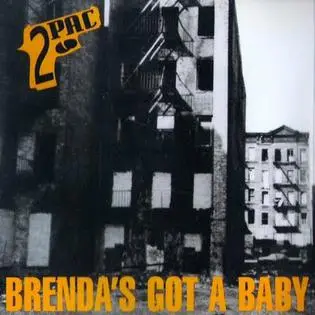
Every discography has a founding track, the one that already contains everything the artist will go on to do. For Tupac Shakur, that track is Brenda’s Got a Baby. Barely four minutes long, released at the end of 1991 on his debut album, written by a twenty-year-old whom almost nobody knew yet. The song tells one story, and only one: a twelve-year-old girl, pregnant by her cousin, gives birth alone, abandons her baby, takes him back, slides into drugs and then prostitution, and dies. It is Tupac’s first case-file song, his first piece of reporting set to music, and to my mind one of the most important texts in the history of rap. I want to read it here in full, slowly, for someone who knows neither the track, nor the artist, nor the world it describes.
Where the Song Comes From: America in 1991 and a Twenty-Year-Old Beginner
Let’s set the scene first. Tupac Shakur, born in New York in 1971, is the son of Afeni Shakur, an activist in the Black Panther Party, the Black revolutionary organization of the sixties and seventies that demanded, among other things, housing, education and an end to police violence. Afeni stood trial in New York alongside other Panthers, handled part of her own defense while pregnant with her son, and was acquitted a month before he was born. I’ve told that story at length in her portrait, but keep the essential point in mind: Tupac grew up in a household where poverty was analyzed as a system, not as individual bad luck. He carried that analytical reflex into his songs.
In 1991 he is still practically a nobody. He has been a dancer and roadie for Digital Underground, a party-minded rap group from the San Francisco Bay Area, he has landed a few guest verses, and he has just won his first film role in Juice, Ernest Dickerson’s picture about four Harlem teenagers. His debut solo album, 2Pacalypse Now, comes out in November 1991 on Interscope, a young Los Angeles label. The record is raw and militant, focused on police brutality and survival in poor neighborhoods. Brenda’s Got a Baby is pulled from it as a single at the very end of 1991, then reissued in early 1992.
The climate matters as much as the biography. Urban America in those years is emerging from a decade of Reagan-era policy that had slashed social programs, and it is being ravaged by the crack epidemic, that smokable, cheap form of cocaine which had devastated entire neighborhoods from the mid-eighties onward. The ghettos, those poor, segregated districts where American history concentrated Black populations, pile up unemployment, failing schools and mass incarceration. The rap of the era talks about all this constantly, often in the register of anger or war chronicle. Tupac chooses a different angle: the individual case, documented, followed through to the end.
The Original News Story: A Press Clipping
Because Brenda’s Got a Baby does not spring from its author’s imagination. While shooting Juice, Tupac reads in the New York Daily News about an incident in a Brooklyn housing project: a twelve-year-old girl, raped by her cousin, had given birth alone on the floor, wrapped the newborn in a plastic bag and dropped him down the building’s trash chute. Maintenance workers, arriving to start up the compactor, heard crying. The baby, umbilical cord still attached, was rescued and treated for hypothermia; the hospital nurses named him Trevor. The story would have an astonishing epilogue: more than thirty years later, that child, now an adult raised on the other side of the country, would discover through a consumer DNA test that he was the baby from the news story, and would find his birth mother, who had been searching for him for twenty years.
Tupac never got to know that ending. All he has is the clipping, and he turns it into something other than an article: a complete trajectory, with a before and an after the newspaper never supplied. He invents a first name, Brenda, he extends the girl’s fate beyond the day of the tragedy, and he shifts the question. The news item asked: how could a child do such a thing? The song asks: what was done, or not done, for this child to end up there? That is precisely the move from news item to thesis, and it is the whole subject of this reading.
The Opening: The Thesis Before the Story
The track does not begin with the story. It begins with a spoken exchange, almost a street scene: someone passes along the news, a girl from the block has had a baby, and another voice waves the information away, on the grounds that it’s nobody’s business but the girl’s family. Tupac then steps in to flip the objection: no, he says in substance, this is not just her family’s concern, it concerns all of us, because what happens to this child touches the whole community around her.
Let’s pause on that move, because it is rare. Most narrative songs save their moral for the end. Tupac does the opposite: he announces his conclusion before he begins, like a sociologist stating a hypothesis before laying out the fieldwork. Everything that follows becomes a demonstration. The listener is warned that this story is not being told for the thrill of it, but to prove something. And that something is a political idea: the private misfortune of the poor is a collective matter. You can hear, very directly, the legacy of the Panthers and of Afeni here. I’ve devoted a whole article to this dimension of the work, Tupac the sociologist, and Brenda’s Got a Baby is its exhibit number one.
The Portrait: A Child Nobody Sees
The narrative proper opens with a portrait. Brenda is twelve, she lives in the ghetto, and Tupac begins by establishing what she does not know: she has no grasp of what a child entails, no real understanding of what is happening to her or of what lies ahead. The narrator makes clear from the outset that he accuses her of nothing: he notes her age, her isolation, her ignorance, which is not stupidity but a lack of instruction, that is to say the failure of everyone who should have instructed her.
Then comes the inventory of absences, conducted with remarkable economy. Brenda’s father is addicted to heroin, a condition Tupac names with the everyday American slang word for someone hooked on hard drugs, junkie, the image of a man whom addiction has emptied of any parental function. The mother is out of the picture. The family, when it appears at all, cares about one thing only: the welfare check, that monthly federal payment to poor households, which Brenda’s pregnancy might increase. In three strokes, the family safety net is described for what it has become: an accounting mechanism in which the child is worth what she brings in.
Then the abuser. Tupac states things with chilling precision: the boy who gets Brenda pregnant is her cousin, older than her, who exploits her naivety by posing as a boyfriend. The song thus names, without using the words, incest and statutory rape, and it underlines that Brenda, for her part, believes she is living a love story, imagines this boy will stay true to her and look after her. The gap between what she thinks she is living and what the listener understands is the text’s first great rhetorical effect: we know what she does not, and that knowledge makes us responsible for her, even if we cannot protect her.
One line from this portrait has lodged itself in every listener’s memory, and I paraphrase it carefully: Brenda cannot even say who runs her own country, yet her pregnant body speaks the plain truth of her circumstances. The image condenses the entire thesis of the song: here is a child the school system never reached, whom public information never reached, for whom the state exists only in the form of a check, and whose body bears the consequences of that wholesale abandonment. It is sociology compressed into a single bar of rap.
The Birth and the Act: The Summit of the Text
The pregnancy advances, hidden. Brenda conceals her belly, nobody notices anything, or nobody wants to notice: school, neighbors, family, everyone looks away. Tupac stretches this silence across several lines, and the silence is itself an indictment. A twelve-year-old, months pregnant, moves through her daily life without a single adult stepping in. The text needs no commentary: the accumulation of averted eyes does the work.
Then the central scene, the hardest one. Brenda gives birth alone, at night, on a bathroom floor. Tupac recounts the moment with a restraint that commands respect: the solitude, the pain, the panic of a child becoming a mother without understanding what is happening to her. And then the act: she throws the newborn into a garbage container. The next line performs the most devastating reversal in the song: she hears the baby crying, and she goes back for him.
We should measure what Tupac accomplishes here. The original news story stopped at the act: a mother discards her baby, workers save him. The song gives Brenda what the article could not: a change of heart, which is to say a conscience. By having her retrace her steps, Tupac refuses to reduce her to her act. She is not a monster; she is a child in over her head who, at the sound of crying, becomes again what she never stopped being: someone who would have wanted to do right. That writing choice is the moral key of the track. A voyeuristic text would have lingered on the horror of the act; this one lingers on the return.
The Fall: The Economic Trap
What follows is a descent, told at an accelerating pace, as if the text itself were running out of time. The family throws Brenda out of the house, baby and all. There she is on the street, no diploma, no trade, no one, with an infant. Tupac then lays out the only arithmetic available to a girl in her position. She first tries selling drugs, the default street commerce of abandoned neighborhoods; but she is too young and too alone, and she is robbed of her supply, which, in that economy, means an unpayable debt. That leaves the last market where her body has a price: prostitution.
Notice the logic of the sequence, because it is the heart of the demonstration. Tupac never says Brenda chooses vice. He shows a succession of closed doors: family, school, employment, public assistance, and then the only two doors left open, dealing and the street corner, the second opening as the first slams shut. This is an analysis in terms of opportunity structure, as sociologists would put it: you understand nothing about the trajectories of the poor unless you look at what is actually within their reach. The song performs that analysis without a single scholarly word, through the sheer mechanics of the narrative.
And the end comes, dry, in one line: a prostitute is found murdered, and the text reveals that it is her, Brenda. Tupac chooses the phrasing of the news brief, the language of the papers, as if the loop were closing: born in one press clipping, Brenda dies in another. The song ends almost on that note, with no consoling epilogue, the chorus circling one last time like neighborhood gossip that keeps on turning. The baby, though, remains. The text does not say what becomes of him, and that final silence may be the most political question in the whole track: who will care for Brenda’s child, if not all of us?
The Music: A Gospel Setting for a Dark Story
All of this could have been merely a text. It is also a record, and its making deserves attention. Production is credited to Big D the Impossible, real name Deon Evans, a regular collaborator of Tupac’s early years, with the Underground Railroad collective. This is early-nineties West Coast sound at its most stripped-down: a mid-tempo pulse, a dry, slightly stiff drum pattern of the kind the era’s drum machines produced, a melancholy piano loop that circles without ever resolving, and very little ornament. Nothing here is trying to make anyone dance. The track is short, with no bridge and no guest verse: the closest possible form to the newspaper article that inspired it.
That bareness is warmed by one decisive element: the voices of Dave Hollister and Roniece Levias, who carry the chorus. Hollister, a future singer with the R&B group Blackstreet, gives the title phrase a gospel coloring, that Black American church music in which lament and consolation live side by side. The effect is that of a neighborhood choir, or a Greek chorus: the community comments on Brenda’s fate, repeats it, turns it into collective memory. The dismissive gossip of the opening becomes, through song, a lamentation.
And then there is Tupac’s own voice, perhaps the most striking thing on a fresh listen. It is young, higher and thinner than the raspy grain we will come to know on the great tracks of 1995 and 1996. His delivery is steady, diligent, almost schoolboyish in places: the delivery of a storyteller effacing himself behind his story. No rage, no showboating, none of the vocal explosions that will build his legend. That restraint is a staging choice: the narrator of Brenda’s Got a Baby is a witness, not a prosecutor.
The video extends this documentary aesthetic. Directed by Allen and Albert Hughes, twin brothers and young filmmakers who two years later would make Menace II Society, it follows the lyrics scene by scene, with a seventeen-year-old, Ethel Love, in the role of Brenda. Tupac appears as a narrator among the residents, never as a star pushed to the front. Again: reportage, not spectacle.
What the Reader Is Owed: What Is Heartbreaking, What Is Debatable
I now have to state both sides of this track, because an honest reading demands it.
What is heartbreaking is beyond dispute. A twenty-year-old man, in 1991, in a genre then largely ruled by masculine bravado, chooses for his first significant single to tell of the rape of a young girl, her solitary childbirth and her death, treating her from start to finish as the victim of a system and never as a culprit or an object of fascination. He does not describe the rape; he names it and moves on. He does not dwell on the body; he dwells on the abandonment. In a culture, well beyond rap, that at the time treated poor teenage mothers as a moral problem and a political target, that simple shift of gaze was an act.
What is debatable exists too, and I won’t sugarcoat it. First, Brenda never speaks. The entire song is told about her, never by her; her inner life is relayed to us by a male narrator who decides what she believes and feels. That is the limit of the device: the most sincere compassion here remains a man’s words about a girl’s fate. Second, the final death, dispatched in a single line, can be read two ways: as the deliberate dryness of the news brief, but also as a dramatic shortcut, the lost girl’s trajectory driven to its most predictable conclusion. The real story, as we saw, ended otherwise. Finally, one may find that the song, while rightly damning the family and the neighborhood, lets the abuser vanish from the narrative after his crime: the cousin answers for nothing, never reappears, and that narrative impunity no doubt mirrors reality, but the text never remarks on it. None of these reservations cancels the track. They simply remind us that it was written by a very young artist, with the tools of his time, and that we can admire it without canonizing it.
What the Song Changed
The reception of Brenda’s Got a Baby outstripped anything its commercial standing would have predicted. The single had a respectable run on the American rap and R&B charts, nothing more; but its effect on the image of the genre was lasting. At a time when 2Pacalypse Now was under public attack, up to and including United States Vice President Dan Quayle, who demanded it be pulled from sale, this track demonstrated that a rap record could be something other than what its accusers claimed: a compassionate piece of reporting, a social inquiry set in rhyme, a gaze trained precisely on the girls nobody looked at. Many listeners, and not only rap fans, understood that day that the genre could carry this kind of story. The whole lineage of great case-file songs in American rap over the following decades descends more or less from these four minutes.
For Tupac himself, the track is a matrix. The tenderness toward women in distress will return in Keep Ya Head Up and all the way to Dear Mama; the method of the individual case built into a demonstration will structure his best texts; and the conviction that the fate of the most fragile implicates everyone will remain his compass, inherited from Afeni and the Panthers. It is also the first great instance of the image he would later make his own, that of the rose that grew from concrete: except that here, the rose did not survive, and the text wants us to ask why. If you’re new to the artist, my beginner’s guide will place the track within the whole; but you can also start right here, precisely because it already contains everything.
There remains the opening statement, the one the song lays down before it even begins its story, and which should be kept as its definitive thesis: Brenda’s misfortune is not her family’s business alone. Tupac took a news item America would have forgotten within a week and turned it into a demonstration that still holds: when a twelve-year-old ends up there, she is not the one who failed; everything that should have held her up failed. Thirty-five years on, nobody has come up with a better answer.
#lecture#2pacalypse now#sociologie