The writings
The Rose That Grew from Concrete: Tupac the Poet
By Selim Rochat · 8 July 2026 · 4 min read
I found this book by accident, in 2001, in an English-language bookshop in Geneva. A slim volume with a rose on the cover and a name I thought I knew by heart. I opened it expecting rap on paper. I found something else. A teenager writing love poems, letters to friends, texts about his mother. Twenty-five years later, it’s still the book I lend out most often.
A collection from before the fame
The Rose That Grew from Concrete came out in 1999, three years after Tupac’s death. But the texts are much older: these are poems written between 1989 and 1991, when Tupac was seventeen to twenty, before his first album was released. Handwritten notebooks, kept by those close to him, which his mother Afeni Shakur had published as they were, with facsimiles of the original pages facing the printed text. You can see the slanted handwriting, the crossings-out, the little drawings in the margins. That layout changes everything: you’re not reading a stage-managed posthumous work, you’re reading a very young man’s notebooks.
A French translation exists, under the title La rose qui poussa dans le béton, in a bilingual edition. It’s the right format for this text: Tupac’s English is simple and direct, and the French version works as a safety net rather than a substitute. Any good bookseller will find it, or order it.
The rose, the concrete
The title poem runs just a few lines and rests on a single image, which I’ll paraphrase: a rose that manages to grow up through a crack in the concrete, and that no one holds to account for its damaged petals, because the miracle is that it grew at all. Tupac would return to that metaphor his whole life, in interviews and in song, to talk about the children of America’s ghettos. You don’t judge the flower on its shape, you salute its tenacity. His entire artistic project, in one image.
The rest of the collection surprises you with its tenderness. Plenty of love poems, addressed to real girls, awkward and sincere the way you are at eighteen. Texts of mourning, tributes, including one to Vincent van Gogh, the figure of the misunderstood genius who fascinated him. And then the political poems, where you hear the direct inheritance of Afeni Shakur, Black Panther militant, who raised her son in full awareness of Black American history. Prison, poverty, Mandela, America’s broken promise: the entire future repertoire is already there, minus the bass.
Read the poems, play the albums
The collection reads perfectly well on its own. It reads even better alongside the records. The 1989-1991 poems shed light first on Me Against the World, the most introspective album, the one where the poet and the rapper nearly merge. The political vein of the notebooks leads straight to the songs devoted to mothers and to the children of the projects. Even the Makaveli album, the darkest one, gains from being heard after this reading: you recognize the reader in it, the man who borrowed his alias from Machiavelli and devoured prison libraries.
My practical advice: read three or four poems, then play an album, then come back to the book. The back-and-forth makes the continuity visible. Tupac did not become a writer after the fact, by the grace of posthumous marketing. He wrote before, he always wrote, and rap was the most powerful vehicle for a writing practice that already existed.
Going further: the reference books
The literature on Tupac is uneven, so let’s sort it out.
In English, two titles stand apart. Tupac Shakur: The Authorized Biography by Staci Robinson (2023) is the estate-authorized biography, fed by family archives and the notebooks; it accompanies Allen Hughes’s documentary Dear Mama, which I discuss in my guide to the posthumous albums. Holler If You Hear Me by Michael Eric Dyson (2001) is less a biography than an essay on what Tupac represents; brilliant, sometimes debatable, always stimulating.
There are also interview collections, including Tupac: Resurrection, drawn from the 2003 documentary and built from his own words. Be wary, on the other hand, of the mass of sensationalist books about his death: theories tend to stand in for sources there, and I’d rather recommend nothing from that shelf.
In French, the pickings are slimmer. Beyond the translation of the poetry collection, you’ll find biographies and essays of variable quality; check the publication date and the sources cited before buying, since the best recent work draws on the archives opened up since Dear Mama. And if you were to own only one book, it would be the bilingual collection. It’s the only one where you hear his voice with no intermediary, the voice from before the trials, before Death Row, before the legend. A nineteen-year-old kid, a pen, and already everything.
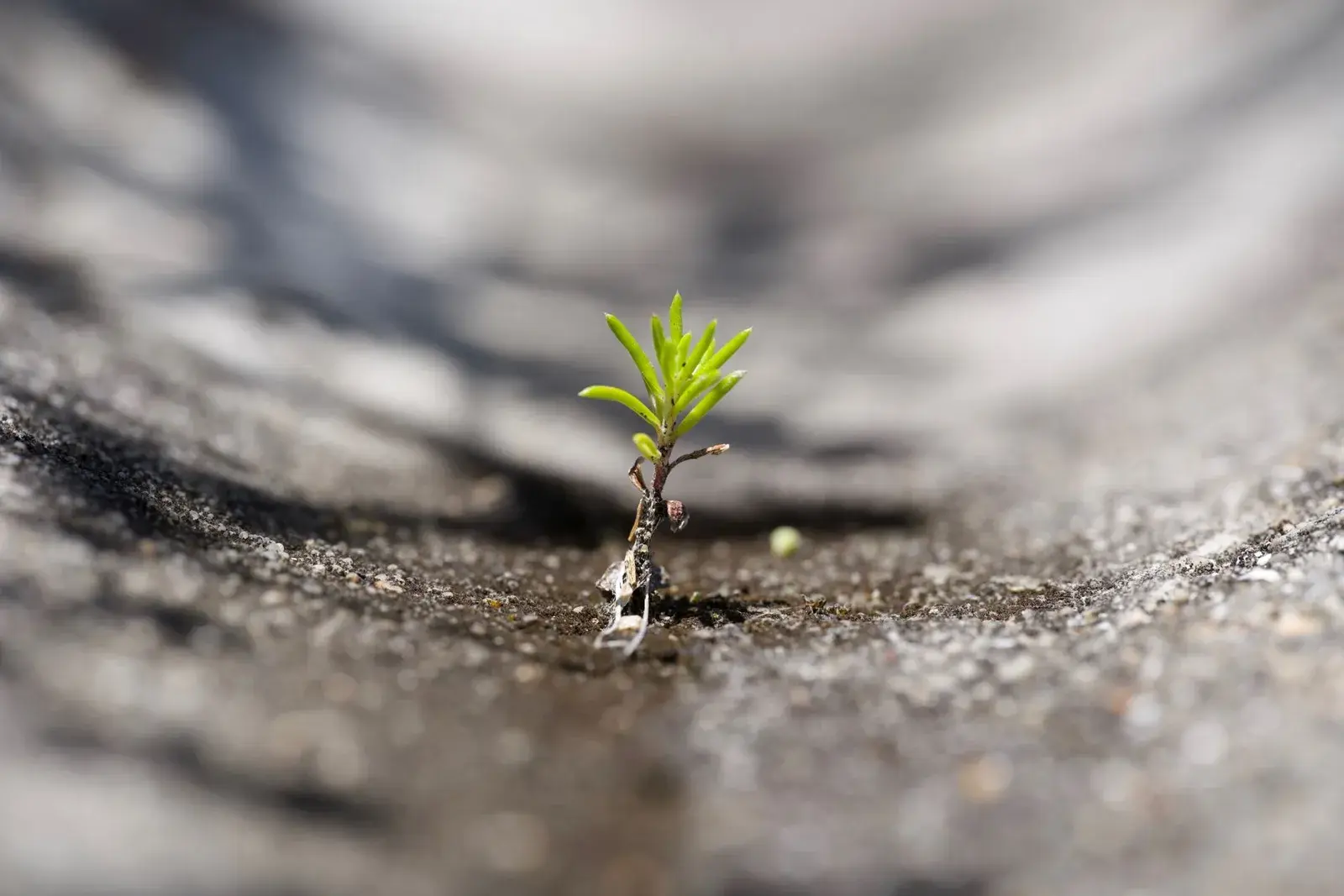
Young green sprout growing out of a crack in a concrete slab, close-up at ground levelLuca (Pexels) · licence Pexels
#poésie#livres#the rose that grew from concrete#afeni shakur#biographies