The legacy
Afeni Shakur: The Mother, the Panther, the Keeper
By Selim Rochat · 9 July 2026 · 5 min read
You understand nothing about Tupac without her. It took me years to truly measure that, and it happened the day I stopped seeing Afeni Shakur as a supporting character in her son’s legend. She has her own story, and that story begins well before June 1971.
Afeni Shakur at a glance
Afeni Shakur was born Alice Faye Williams on January 10, 1947, in Lumberton, North Carolina. In November 1968 she married Lumumba Shakur, also a member of the Black Panther Party, and divorced him in 1971. The Panther 21 trial opened on September 8, 1970 and ended in acquittal eight months later. In 1975 she married Mutulu Shakur, with whom she had a daughter, Sekyiwa; they divorced in 1982. She died on May 2, 2016, at the age of 69, in California.
The Panther of the 21 trial
In the late sixties, Afeni Shakur was an activist in the New York section of the Black Panther Party, in Harlem. She organized there, she wrote there, she took on responsibilities. In April 1969, police arrested twenty-one members of the chapter, accused of a sweeping conspiracy targeting police stations and public places across New York. The Panther 21 case became one of the longest political trials in the state’s history.
What Afeni did there defies belief. Released on bail then jailed again, pregnant, facing decades in prison, she chose to conduct part of her own defense, the only defendant to argue without a lawyer at her side. Facing the jurors, she cross-examined an undercover informant and got him to admit the driving role the agents had played in the alleged acts. On May 13, 1971, the jury acquitted the defendants on all 156 counts. A month later, on June 16, she gave birth to a son she would rename Tupac Amaru Shakur, after the last leader of the Inca resistance. The boy was quite literally born out of a victory over the machinery of the state. His entire relationship to the world flows from that.
The dark years
What followed was less glorious, and Afeni never dressed it up. The seventies and then the eighties were one long crossing of precarity: the endless moves between New York, Baltimore and California, the shelters, the welfare checks. By the late eighties she had sunk into crack addiction, at the very moment her teenage son was starting to write. The wound ran deep on both sides. Tupac would speak about it publicly, bluntly but without disowning her, and in 1995 he turned it into one of the most devastating gestures in rap history: Dear Mama, a tribute to a mother looked at squarely, her failings and her greatness intertwined. I’ll point you back to what I wrote about Me Against the World, the album that carries the song. The reconciliation, for its part, was already under way: Afeni had gotten clean in the early nineties and would stay sober. The superstar son and the rebuilt mother were learning to talk to each other again when everything stopped.
The keeper
September 1996. Tupac dies in Las Vegas at twenty-five, without a will, leaving behind dozens of unreleased songs and a tangle of contracts. It’s Afeni who steps into the breach. She fights to recover the recordings, founds Amaru Entertainment, and takes charge of the posthumous releases, from R U Still Down? as early as 1997 through the compilations of the 2000s such as Until the End of Time. You can argue about the uneven quality of those releases, and I have, in my guide to the posthumous albums. But remember the context: without her, that catalogue would have been sold off piecemeal to rights-holders with no scruples.
She didn’t stop at the music. In 1997 she created the Tupac Amaru Shakur Foundation, devoted to arts programs for young people, which would later open an arts center in Georgia. In 1999 she published her son’s early poems, the collection whose importance I recounted in The Rose That Grew from Concrete. She also watched over the narrative itself: years before her death, she entrusted the project of a definitive biography to Staci Robinson, a childhood friend of Tupac’s. The book would appear in 2023, and I discuss it in my guide to the biographies.
After her
Afeni Shakur died on May 2, 2016, in California, at sixty-nine. Almost twenty years to the day after losing her son, she left behind a protected body of work, an active foundation, intact archives.
The great telling of her life arrived seven years later. Dear Mama, the documentary series by Allen Hughes broadcast in 2023, borrows the song’s title to tell the story of mother and son in parallel, the activist and the artist, like two versions of the same fight. To my mind it’s the most honest thing ever made about them, and I come back to it in my survey of the documentaries. The gesture is a beautiful one: the 1995 song was the son’s gaze upon the mother; the 2023 series returns the gaze.
Thirty years after her son’s death, what she salvaged can still be measured: the catalogue, the foundation, the archives. I gathered what those three decades made of him in Thirty Years Without Tupac.
The rose of the poem grew from the concrete, yes. But someone had planted the seed, and stood guard over the sidewalk. Her name was Afeni.
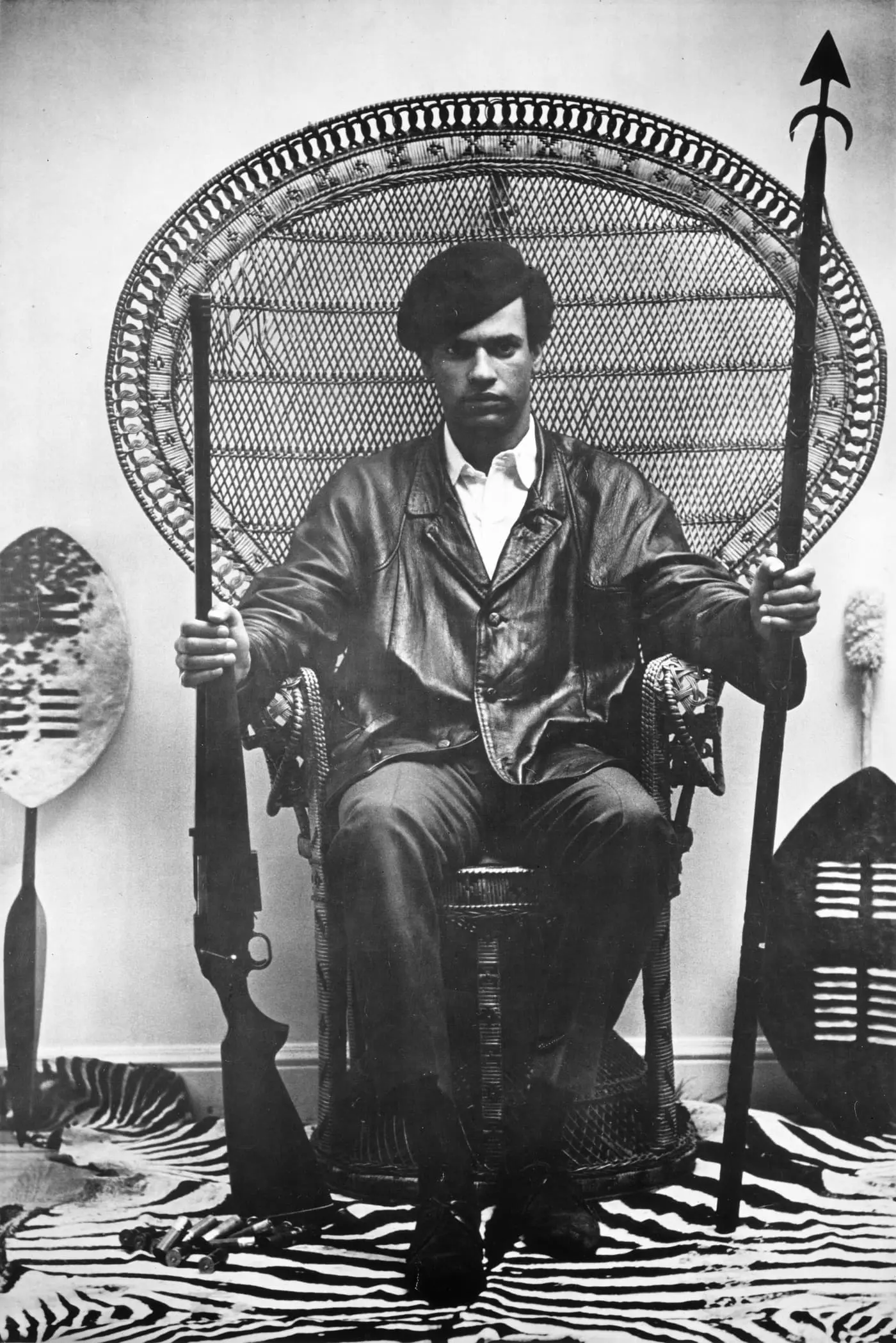
Huey P. Newton, co-founder of the Black Panther Party, seated in the famous rattan chair holding a spear and a rifle, circa 1968Blair Stapp · domaine public
#afeni shakur#black panthers#heritage