The legacy
September 7, 1996: The Las Vegas Night, Thirty Years On
By Selim Rochat · 23 July 2026 · 7 min read
Thirty years. It took thirty years, almost to the day, for the night of September 7, 1996, to finally reach a jury. On August 10, 2026, in a Clark County courtroom, Duane Davis, known as Keffe D, the only man ever charged in the murder of Tupac Shakur, goes on trial. Three weeks later, the whole world will mark the thirtieth anniversary of the shooting. I’m not inventing that symmetry for dramatic effect. It’s the accident of judicial delays that ended up stacking the trial on top of the commemoration. So before the hearings drown everything out, I want to lay down what we know about that night, hour by hour, and what we still don’t. I’ve already explained why the mystery changes nothing about the work. What follows is not mystery. These are the facts.
The Day: A Boxing Match and the Promise of a Party
On Saturday, September 7, 1996, Las Vegas is packed. Mike Tyson is fighting Bruce Seldon at the MGM Grand, and a Tyson fight in that era is the event that pulls in every celebrity America has to offer. Tupac is in the arena, in the front rows, with Suge Knight, the boss of Death Row Records. The fight lasts less than two minutes, Seldon goes down, and the crowd flows back toward the casinos. It’s roughly a quarter to nine in the evening.
The night turns for the first time in the lobby of the MGM Grand. Someone in the entourage spots Orlando Anderson, a young man from Compton affiliated with the South Side Crips, whom the Death Row camp suspected of taking part in the theft of a medallion belonging to someone close to the label a few weeks earlier in Los Angeles. Tupac charges, throws punches, the entourage piles in, and casino security breaks it all up within seconds. Surveillance cameras capture the scene. It’s brief, and no one is arrested. Anderson even declines to press charges at the time. On the footage you can see Tupac walking away, fired up, surrounded, alive. These are among the last images of him on his feet.
Everyone involved knows what comes next: Suge Knight is throwing a party at Club 662, a venue he controls on Flamingo Road, away from the Strip. Tupac stops back at his hotel, the Luxor, changes clothes, rejoins the convoy at Knight’s place, and the cars head out in a procession toward the club. Tupac takes the front passenger seat of the black BMW 750 that Knight himself is driving. One detail will weigh heavily: he’s not wearing the bulletproof vest he often puts on. It’s hot out, and the night is supposed to be a celebration. Behind them follow several vehicles from the entourage, including the one carrying the Outlawz, his group.
Quarter Past Eleven: Two Hundred Seconds at a Red Light
Around eleven p.m., the convoy rolls down the Strip, stops once so police can tell Knight the sound system is too loud and the plates are missing, then moves on. Shortly after 11:10 p.m., the BMW comes to a halt at a red light at the corner of Flamingo Road and Koval Lane, a few hundred yards from the club. A white Cadillac pulls up alongside, on the passenger side. A hand levels a pistol out the rear window and empties the magazine into Tupac’s door. At least ten rounds are fired. Four hit Tupac, in the chest, the pelvis, the hand, the thigh. Knight is grazed on the head. The Cadillac turns and vanishes. The whole thing lasts a few seconds, in front of dozens of witnesses, in the heart of what is probably the most heavily surveilled city in the United States.
Knight makes a U-turn and drives against traffic on bare rims until police intercept him. Tupac is conscious when first responders arrive. He’s taken to University Medical Center, operated on several times, and placed in a medically induced coma. His mother, Afeni, whose extraordinary path I’ve written about, settles in at his bedside. For six days, all of America follows the medical bulletins. On Friday, September 13, 1996, at 4:03 p.m., doctors pronounce him dead. Tupac Shakur was twenty-five years old.
The Investigation That Went Nowhere
What follows fits in one sentence I’ve written elsewhere and will repeat because it remains staggering: for twenty-seven years, this murder committed in public produced not a single indictment. The Las Vegas police always maintained that witnesses refused to talk, Tupac’s own entourage first among them. That’s partly true, and partly too convenient: investigators in Compton had very quickly documented the theory of a feud between the Death Row camp, tied to the Mob Piru Bloods, and the South Side Crips, in the direct aftermath of the MGM Grand altercation. Orlando Anderson’s name was circulating within the first weeks, on the street and in police reports alike. Anderson always denied it, was never charged, and died in 1998 in a shooting unrelated to the case, in Compton. With him went the main suspect named by rumor, and the file closed for a quarter of a century. The East Coast-West Coast war provided the backdrop, the tit-for-tat retaliations in Compton in the fall of 1996 were probably its first act, and the courts never ruled on any of it.
The case only reopened because one man started talking. Beginning in 2018, Duane Davis, Orlando Anderson’s uncle and a figure in the South Side Crips, said in televised interviews and then in a memoir published in 2019 that he was in the white Cadillac that night. In September 2023, a Nevada grand jury indicted him for murder with an aggravating circumstance. He was arrested on September 29, 2023, near Las Vegas. He is past sixty, he is by his own accounts the last living occupant of that car, and he has pleaded not guilty.
Where the Trial Stands, Exactly
Here is the state of the case as I write, in July 2026, and I’m sticking to the procedural record. The trial has been postponed twice: first from March 2025 to February 2026, at the request of the defense, which wanted time to interview witnesses, then from February to August 10, 2026, because of the sheer volume of the case file. Davis has been held without bail since his arrest. On June 30, 2026, Judge Carli Kierny issued two significant rulings: his memoir and past interviews may be presented to the jury, the judge having found that he had adopted the book’s statements as his own, and the jury will be partially sequestered during the proceedings, the full sequestration sought by the defense having been denied. The most recent status hearing was held in mid-July. Barring another delay, the jurors will therefore be sitting while the world commemorates the thirtieth anniversary of the shooting.
And now the sentence that has to be written, because everything else depends on it: Duane Davis is presumed innocent. His trial will turn precisely on the value of his own accounts. The prosecution sees them as confessions repeated over years; the defense argues he embellished or invented his role to sell a story, which, in the world of gangsta rap and its legends, would be nothing new. A jury will decide. That is exactly what never happened in thirty years, and it’s the only development that matters: whatever the outcome, this night is finally going to be examined in public, under oath, piece by piece.
What Thirty Years Have Made of That Night
I’ll end where I always begin. The Las Vegas night has become a mythological narrative, with its minute-by-minute reconstructions, its documentaries, its theories that I’ve already poked fun at, with some affection. The trial will stir all of it back up, and part of what gets written between now and September will be noise. But beneath the noise sits a fact that thirty years haven’t moved: that night, at twenty-five, one of the densest artistic trajectories of the century came to a stop. Five albums in five years, hundreds of tracks, and that way of holding rage and tenderness together that I try to describe article after article on this site. What these thirty years have made of his legacy now lives on the hub page of the anniversary fortnight, thirty years without Tupac, updated through September 13. While we wait for the hearings, the best tribute is still the simplest one: listen. You can start with ten tracks to understand him, and let the court, at long last, do its work.
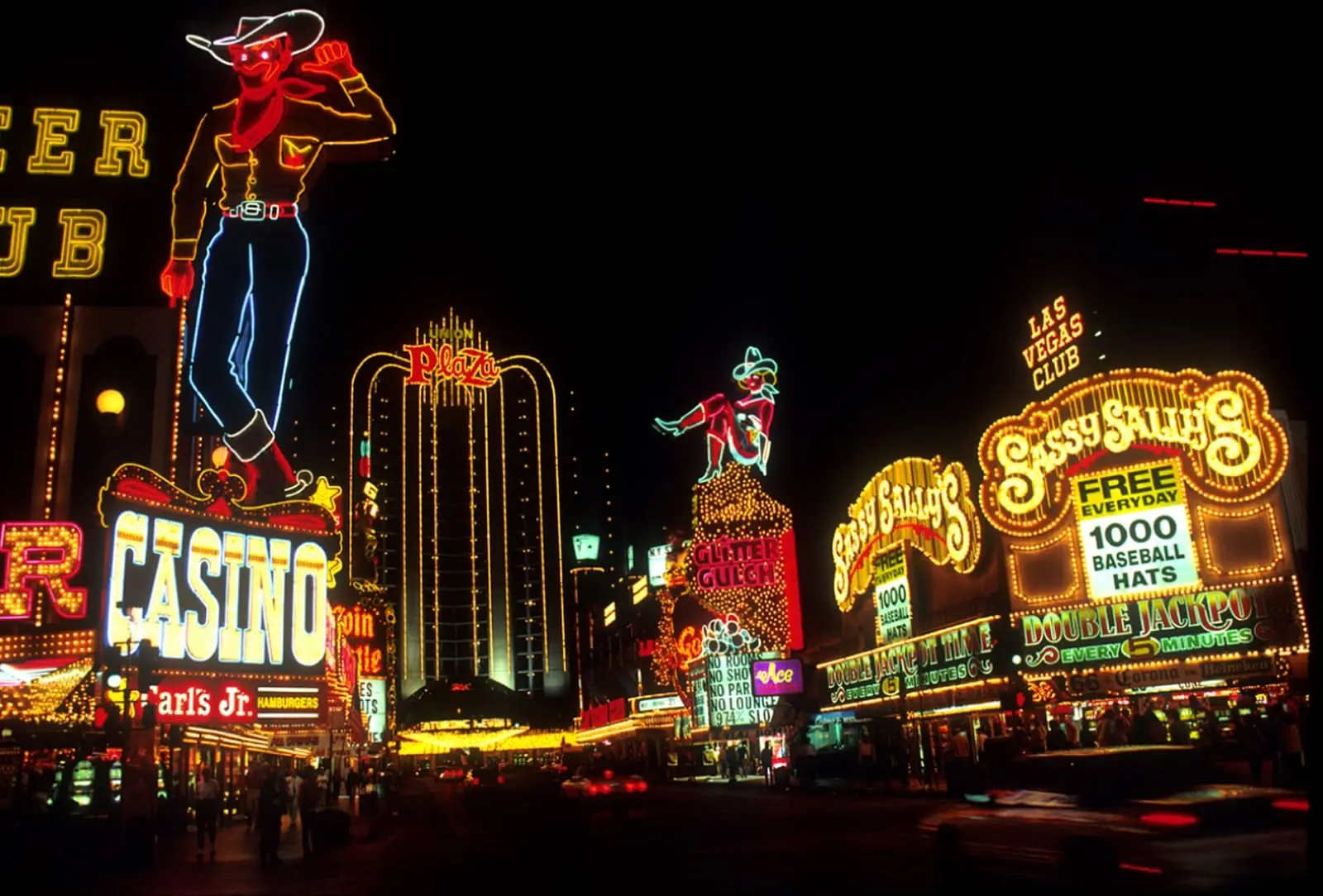
Las Vegas at night, classic neon signs of the Strip saturating the darkness with red and goldinconnu (archives NARA) · domaine public
#heritage#las-vegas#proces#chronologie