Close readings
Hit 'Em Up, a full reading: anatomy of a public reckoning
By Selim Rochat · 9 July 2026 · 20 min read
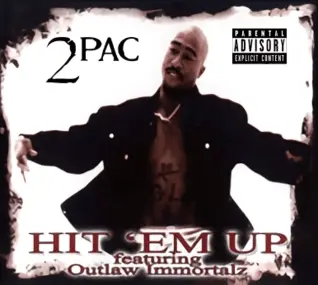
Hit ‘Em Up is one of the most violent tracks Tupac Shakur ever recorded. To understand it, you first have to accept that it is not merely an aggressive song. It is a public reckoning, taped in the middle of a war that was at once symbolic, commercial and personal, a war between two poles of American rap in the 1990s: the West Coast, associated above all with Los Angeles, Death Row Records and Tupac; and the East Coast, associated with New York, Bad Boy Records, Puff Daddy and The Notorious B.I.G. I’ve told the story of that war without the folklore elsewhere on this site; here, we go into the text itself.
The players
Tupac Shakur, also known as 2Pac, was by then one of the most famous and most controversial rappers in the United States. He was many things at once: rapper, actor, poet, activist shaped by a Black Panther milieu, child of urban poverty, media figure, prisoner, survivor of a shooting, global star. His work swings between social compassion, political anger, intimate confession, sexual provocation, street violence and personal mythology.
The Notorious B.I.G., often called Biggie Smalls or simply Biggie, was the great New York rapper on Bad Boy Records. His real name was Christopher Wallace. At that moment he embodied the spectacular success of East Coast rap. His style was expansive, narrative, precise, deeply musical, carried by a low voice you recognize instantly. He was close to Sean Combs, known as Puff Daddy, Puffy, later Diddy, the founder of Bad Boy Records.
Tupac and Biggie did not start out as enemies. They knew each other, spent time together, liked each other. Tupac was already famous when Biggie was coming up. According to the memory Tupac stages in Hit ‘Em Up, he had even helped Biggie at the start, welcomed him, advised him, let him into his world. Whether every detail holds up matters less here than Tupac’s perception: on the record, he speaks like a man who believes he was betrayed by someone he had allowed to get close.
The central trauma is the shooting of November 1994 at Quad Recording Studios in New York. Tupac was attacked there and hit by several bullets. He survived. Afterward he came to believe that his New York circle, or at least people connected to that milieu, had not been innocent in the affair, or had not reacted the way he expected. Biggie and Bad Boy always denied any involvement. But in Tupac’s imagination, the physical wound became existential proof: he was hit, he survived, and he returns to accuse.
That is the climate in which Hit ‘Em Up must be read. The track is not a simple artistic rivalry. It is spoken from a zone of paranoia, resentment, genuine fear, industrial competition, wounded masculinity and media theater. Tupac isn’t looking for a debate. He is looking to destroy someone in public.
The opening: no friends left, no limits left
The intro begins with a declaration of solitude: Tupac states, in essence, that friendship no longer exists for him. That sentence is crucial. It means the track does not begin only in a star’s pride, but in a feeling of abandonment. The speaker presents himself as isolated, betrayed, cut off from ordinary bonds. If no friends remain, then no loyalties remain to be spared. He can say anything.
The line that follows goes after Biggie through the body, through weight, through sexuality and through conjugal humiliation. Tupac claims, as pure provocation, to have slept with his rival’s wife. The target is Faith Evans, R&B singer and Biggie’s wife at the time. Precision matters here: the track wields this claim as a rhetorical weapon. Its purpose is to humiliate Biggie publicly, to strike at his manhood, his marriage, his image. The poetic and strategic interest is not whether the claim is true. It is what the claim does inside the text. It turns a musical war into an intimate wound.
From the very first bars, then, Tupac sets the track’s rule: nothing will be protected. Not family, not the body, not the wife, not the label, not friends, not illness, not symbolic deaths. Hit ‘Em Up operates as a text with no internal moral limit. Anything that can hurt the enemy is fair material.
Westside against Bad Boy
When Tupac says Westside, he plants himself in the West Coast camp. In 1990s American rap, the opposition between West Coast and East Coast had become an immensely powerful media fiction. It never meant that every rapper in the West hated everyone in the East. Reality was messier. But record labels, magazines, radio stations, videos and personal feuds turned that opposition into a collective narrative. Tupac takes the narrative and turns up the heat.
Bad Boy means Bad Boy Records, Puff Daddy’s label, based in New York. When Tupac speaks of Bad Boy’s supposed killers, he isn’t pointing at Biggie alone. He attacks the whole institution: the label, its founder, its artists, its aesthetic, its prestige, its commercial power. The track is also, in that sense, an assault on a music company.
The first verse: defile first, refute later
The first verse opens with a blanket insult aimed at the rival’s woman and at his whole entourage. It’s brutal, direct, obscene. Tupac does not begin with an argument. He begins with an act of defilement. In the track’s logic, the adversary must be soiled before he is refuted. The clash is designed as a demolition of prestige.
The verse then announces that the West Coast camp never moves without game. Game does not only mean play. In this context it names a social and criminal competence, an ability to read power relations, to seduce, to survive, to manipulate, to act at the right moment. Tupac isn’t presenting himself as merely violent. He is presenting himself as sharper than his enemies.
When he mocks Biggie for posing as a player while, as the song alleges, his own wife could be taken, he attacks the coherence of Biggie’s public persona. A player is a man who commands women, desire, the social game, masculine prestige. Tupac flips that image: if your wife can be had, then you are not the player you claim to be. The attack is crude, but its function is plain: rip the mask of dominance off the adversary’s face.
Next, Tupac declares that Bad Boy is condemned for good. The track converts a rivalry into fate. He isn’t saying: we have a dispute. He is saying: this war will never close. It is one of the most unsettling aspects of the text: it deliberately seals off any possibility of peace.
Puffy appears as the boss of the opposing camp. Tupac paints him as weak, as someone who might want to see him or face him but whose heart wouldn’t hold. In Tupac’s vocabulary, heart is essential. Having heart means courage, hardness, the capacity to stand firm in front of fear. To say a man’s heart is soft is to strip him of his warrior masculinity.
Biggie Smalls and Junior M.A.F.I.A. are then folded into the same attack. Junior M.A.F.I.A. was the group tied to Biggie, including Lil’ Cease and Lil’ Kim. Tupac does not aim at the chief alone. He aims at the whole court. That strategy runs through Hit ‘Em Up: nobody around the enemy stays neutral. The entourage becomes an extension of the main target. Lil’ Cease, a young rapper close to Biggie, gets treated as a flunky. Lil’ Kim is attacked in sexual, misogynistic, degrading terms. The track works by contamination: belonging to Biggie’s circle is enough to be marked.
The violence directed at Lil’ Kim is particularly revealing of the text’s brutality. Tupac does not attack her only as an artist. He attacks her body, her sexuality, her presence in the street. It is typical of the track: women here are used as surfaces for masculine humiliation or as direct targets of sexualized verbal violence. Say it plainly: the text is misogynistic. That misogyny is not incidental. It belongs to the track’s machinery of crushing.
When Tupac declares that peace holds no interest for him, he strips battle rap of its usual frame. In rap, verbal confrontations can be ferocious while remaining contests of style. Here, Tupac claims to step outside the game. He announces that the hostility runs for life. That is what gives the track its dimension of total war.
The phrase murdered on wax deserves a pause. Wax refers to the record, the physical medium of music. To be murdered on wax is to be killed symbolically on the recording. It’s a classic formula of metaphorical violence in rap, but here it resonates dangerously, because the real context was already loaded with shootings, guns, threats and looming deaths. The metaphor brushes too close against reality.
The hook: survival as threat
The hook is built on a simple image: catching sight of Tupac should send people reaching for a firearm or dialing the police. In other words, his mere presence is framed as immediate danger. Tupac does not want to be recognized simply as an artist. He wants to be perceived as a threatening event.
The question the hook raises, the question of who was behind the gunfire that hit him, points straight back to the 1994 shooting. But within the track, the question isn’t really open. It works as an accusation. Tupac implies that his enemies know, that they are tied to the wound, or that they profited from the attack. This is not evidence. It is a dramaturgy of suspicion.
The next idea is decisive: the attempt on his life was botched. The thought is simple and terrible: they tried to bring him down and failed; now they must face the man who lived. Tupac builds himself as a revenant. He is not merely alive. He is alive against them. His survival becomes a threat.
That transformation of the wound into authority is one of Tupac’s great gestures. In other texts, he turns the wound into compassion, as in Dear Mama, or into social conscience, as in Keep Ya Head Up. Here, he turns it into a right of vengeance. The same poetic energy changes direction: instead of shielding the humiliated, it sets out to humiliate the enemy.
The Outlawz: the troop takes the stage
After the hook, Tupac claims he barely knows why he’s even on the track, since his adversaries supposedly aren’t at his level. The sentence has a hierarchical function. He places himself above the conflict while participating in it fully. He is saying: you don’t even deserve my attention, but I’ll crush you anyway.
He then announces that his young allies will carry on. These are the Outlawz, the group tied to Tupac, whose names often echo dictators or political enemies of America: Kadafi, Hussein Fatal, E.D.I. Mean. Their presence turns the track into a collective operation. Tupac is no longer alone. He commands a troop.
Hussein Fatal’s verse attacks Biggie from another angle. It conjures a scene of direct violence, with guns, shots, ambushes, physical humiliation. This verse lacks Tupac’s confessional depth. It functions instead as aggressive reinforcement. Its job is to suggest that the threat comes not from a single voice, but from a group ready to act.
The reference to Frank White targets Biggie. Frank White is the lead character of the film King of New York, played by Christopher Walken. Biggie used the nickname to give himself the aura of a New York crime boss. Attacking Frank White therefore means attacking Biggie’s gangster mythology. The message is essentially: you fancy yourself the criminal king of New York, but you are nothing more than a target.
Fatal also goes after Puffy and Junior M.A.F.I.A. He paints them as weak, smoked out, destroyed, ridiculed. The vocabulary of drugs, weapons, dealing and designer clothes anchors the verse in the gangsta rap imagination: money, street, menace, consumption, status. The objective never changes: deny Bad Boy its prestige.
Then the hook returns as a reminder of the central figure: Tupac is the man to be feared precisely because the attempt to kill him failed. Its repetition has an almost ritual function. It engraves the track’s equation into memory: Tupac sighted equals danger.
The third verse: the couch and the five bullets
Tupac’s third verse is the literary core of the text. It opens on the idea that authenticity has the hardness of prison metal. The image is hard and exact. The real, for Tupac, is not a moral abstraction. It is prison, metal, confinement, the coldness of the system. Authenticity flows from the experience of constraint.
When he says this is no freestyle battle, he states his intention clearly. A freestyle battle is a verbal contest, often improvised or presented as such, where two rappers face off through rhymes, insults and virtuosity. Tupac rejects that frame. He does not want Hit ‘Em Up understood as an exercise in style. He wants it received as a symbolic execution.
He then accuses his adversaries of running their mouths, of trying to build a name off his, of dreaming of altitude while living in illusion. The images of drugs and false flight serve to ridicule their pretension. They think they are soaring, but they’re merely intoxicated. They believe they’re rising, but they’re heading for the burn.
The passage about money sets Tupac against his enemies. He presents himself as a millionaire who built his fortune alone. In the America of rap, that formula carries weight: it asserts independence, success without inheritance, the passage from poverty to power. But Tupac immediately welds that success to thug life, to prison, to guns. He has no wish to become respectable in the bourgeois sense. He wants to be rich without ceasing to be dangerous.
Then comes the most personal moment of the track: Tupac addresses Biggie directly and recalls that he once let him sleep at his place, or near him, in a situation of dependence. The detail is humiliating. It drags Biggie back to a past of need. The New York star is reduced to a man who once needed a couch, a roof, a permission. Tupac is trying to shatter Biggie’s majestic image by recalling a domestic scene of vulnerability.
This passage exposes the emotional core of Hit ‘Em Up: betrayal. Tupac does not speak merely as a competitor. He speaks as someone who believes he was used, imitated, then discarded. The track’s violence flows from that lost intimacy. The stronger the old closeness, the more ferocious the present attack. That is the thread I pull in the piece on the betrayals; here, it surfaces in every line.
The accusation of imitation follows logically. Tupac asserts that Biggie lifted his style. In rap, the originality of voice, flow, posture and persona is everything. To accuse someone of copying a style is not merely to accuse him of lacking inspiration. It is to accuse him of imposture. For Tupac, his enemies wear the insignia of the hard life without having paid its existential price.
The reference to the five bullets he took is the mythological summit of the verse. Tupac recalls that several rounds hit him and that he lived. He even claims to have met the wounds grinning. The image is almost heroic. It converts a shooting victim into an invincible figure. The wounded body becomes proof of superiority.
When he announces that he will correct the story, and names an assault rifle, the AK, as the instrument of that correction, he fuses truth and violence. Normally, correcting a story means fixing a narrative, restoring facts. In Tupac’s hands the clarification is welded to a weapon of war. Truth is no longer separate from menace. Here, telling the truth means striking.
The widening: a map of war
The verse from Kadafi and E.D.I. Mean shifts the geography again. It brings in New Jersey, another East Coast territory, and continues the assault on Junior M.A.F.I.A. The function of this passage is to show the conflict spilling beyond New York and Los Angeles. Networks multiply. Crews answer crews. Rap becomes a map of war.
The references to Lil’ Cease and Lil’ Kim come back. That repetition is meaningful. The track never releases its secondary targets. It wants Biggie’s entire ecosystem marked. The logic is a siege: strike the chief, then the entourage, then the label, then the allies, then the admirers.
E.D.I. Mean’s verse revives the artistic accusation: the adversary is called a beat thief, a style snatcher, an imitator. It is one of the most important charges in the track, because it touches artistic legitimacy. In Hit ‘Em Up, being fake is worse than being weak. Weakness can be despised; fakeness must be exposed.
The comparison with a sweet, mildly alcoholic drink serves to cast the adversary as soft, sugary, without hardness. The device is pure machismo. The track’s whole value system rests on an opposition between hard and soft, real and fake, street and luxury, survivor and imitator, clan and industry. That logic is brutal, but coherent.
The spoken ending: when the form gives way
The spoken ending is a decisive moment. Tupac barely raps anymore. He talks, laughs, provokes, insults, names names. The structure of the track comes apart. The anger seems to overflow the song. The effect is one of raw authenticity, even if that authenticity is itself a performance. The listener feels that musical form can no longer contain the rage.
When Tupac demands to know who won, he isn’t really asking. He is declaring victory. The laugh that follows is a laugh of domination. It seeks no complicity. It ridicules the enemy. Laughter becomes a sonic weapon.
He then attacks Mobb Deep, the New York duo of Prodigy and Havoc, important on the East Coast for their dark, cold, criminal, paranoid universe. Tupac targets them because they fed the climate of hostility around him. The passage where he mocks Prodigy’s illness is especially cruel. Prodigy suffered from sickle cell disease. Tupac wields that physical fragility as an instrument of humiliation. It is one of the most morally abject moments of the track.
That attack shows that Hit ‘Em Up respects no boundary. Illness, the wife, the children, the label, the mother, the body: everything can be turned into insult. The text has a terrifying coherence: it wants to make dignity impossible for the adversary.
When Tupac says the matter was originally between him and Biggie alone, but that everyone weighed in, he justifies the widening of the target. By his logic, those who talk become involved. There is no neutrality. Any position taken, real or supposed, turns a person into an enemy.
The long string of curses against Mobb Deep, Biggie, Bad Boy, Chino XL and anyone who would want to stand with Bad Boy is the conflict stretched to its maximum. Chino XL was a rapper who had thrown a jab at Tupac in a song. So Tupac adds him to the blacklist. This section works like a registry of enemies. The text no longer analyzes. It condemns by naming.
The line aimed at Bad Boy as staff, label and crew is particularly important. Tupac is not going after private individuals alone. He attacks a complete industrial structure: a record company, a brand, a team, a commercial aesthetic. He is also targeting the economic power that manufactures and sells his enemies’ image. And when he adds that anyone wishing to join Bad Boy falls under the same threat, he formulates a policy of total war. The world splits in two. Whoever is not with Tupac is counted with the enemy.
The passage where Tupac invokes his adversaries’ children is among the most violent and least defensible. This is no longer about humiliating adult rappers. The threat spills toward lineage, toward the future, toward family. Even within the hyperbolic language of confrontational rap, the effect is chilling.
From solitude to clan
The ending returns to Thug Life and the Westside. Thug Life is a central notion in Tupac’s world: at once an outlaw identity, a solidarity with the criminalized poor, a posture of resistance and a personal brand. Tupac also gave the expression a political meaning: thug life is what a society produces when it abandons certain children and then punishes them once they turn violent. But in Hit ‘Em Up, that social dimension is flattened by the war logic. Thug Life becomes, above all, a clan cry.
The track opens in absolute solitude and closes in collective belonging: Westside, Thug Life, the riders, the camp. That progression is essential. At the start, Tupac declares himself friendless. At the end, he speaks in the name of an armed we. Wounded solitude has become a community of war.
What to take from it
For an uninitiated reader, the central stakes are these: Hit ‘Em Up stages a man who believes he was betrayed, attacked, imitated and abandoned. Instead of answering with a calm justification, he answers with total destruction. He attacks bodies, reputations, marriages, labels, groups, illnesses, families and the mythologies of his adversaries.
The track is poetically powerful because it follows a very clean escalation. First the solitude. Then the intimate humiliation. Then the naming of enemies. Then the recall of the shooting. Then the entrance of the allies. Then the accusation of fakeness. Then the claim of survival. Then the general curse. This is not a scattered song. It is a controlled rise in intensity.
Its language is simple, direct, repetitive, obscene, and extremely effective. Tupac uses direct address: he speaks to his enemies as if they stood in front of him. He uses enumeration: proper names pile up until the track feels like a hunt. He uses hyperbole: the words claim to kill. He uses laughter: not as joy, but as humiliation. He uses his own wounded body as evidence: the bullets he took become a poetic argument.
Power and moral worth must nonetheless be kept apart. Hit ‘Em Up is a powerful track and a morally ugly one. Its misogyny is obvious. Its cruelty is explicit. Its pleasure in humiliation never lets up. It should not be softened. This is not a mere verbal game. It is a text that helped amplify a climate of very real hatred.
But it should not be reduced to stupid provocation either. The track is historically decisive because it condenses several forces at once: the violence of heavily mediatized 1990s rap, the rivalry between labels, the economy of scandal, Tupac’s trauma, his obsession with authenticity, his fear of betrayal, his need to be recognized as a survivor, and his ability to turn his wound into sonic theater.
Within Tupac’s body of work, Hit ‘Em Up represents the darkest face of his poetry. The same artist wrote texts of immense tenderness about his mother, about poor women, about lost children, about loneliness, death and hope. Here, that tenderness is gone. What remains is the wound turned weapon.
That is why Hit ‘Em Up must be read as a war text, not as a mere song of insults. It is brutal, excessive, often repugnant, and built with fearsome efficiency. It shows Tupac at the moment when his poetry no longer tries to save, console or explain. It only tries to strike.
Perhaps the fairest formula is this one: Hit ‘Em Up is the speech of a survivor who refuses to be a victim and who, to prove he is still alive, chooses to become a threat. That is its force. It is also its disaster.
#lecture#death row#guerre des côtes