Listening guides
The Betrayals: What 1994-1996 Did to His Music
By Selim Rochat · 9 July 2026 · 5 min read
There is a listening exercise I recommend to everyone, though I should warn you that you don’t come out of it unscathed. Take a track from Me Against the World, then play a track from The Don Killuminati immediately after. Eighteen months separate the recordings. It sounds like ten years, or another life. In between, something happened that the biography names precisely: a series of betrayals, real or experienced as such. This article is about how they became a sound.
Quad Studios, November 1994: the night that cracks everything
On November 30, 1994, Tupac went to Quad Studios in Times Square to record a guest verse. In the lobby, three men attacked him, stripped him of his jewelry and shot him. He survived five gunshot wounds, two of them to the head. The next day, bandaged, in a wheelchair, he attended the verdict in his trial. The facts stop there. The rest is interpretation, and it’s the rest that would poison everything.
Because in the same building that night were Biggie Smalls and Sean Combs. Tupac would come to convince himself that his ambush had been ordered, or at the very least known about in advance, by his New York circle. Let’s say it without ambiguity, because honesty demands it: that suspicion has never been proven. Biggie and Combs always denied any involvement, and nothing solid ever contradicted them. But in the history of art, what counts is not what is true, it’s what the artist believes. And Tupac, who regarded Biggie as a friend, almost a protégé, now believed the hand that struck him came from his own table. That is the exact definition of betrayal, and it sets in motion everything my page on the coastal war recounts.
1995: the conviction as a second abandonment
In February 1995 he was sentenced to prison in a sexual abuse case, a verdict he would contest for the rest of his life, saying he was guilty of failing to prevent anything but not of acting. I’m not retrying the case here. What interests me is how he lived it: as one more betrayal. Betrayal by the woman accusing him, as he saw it; betrayal by the friends present that night who faced no charges; betrayal by a justice system that, in his eyes, was finishing what the bullets had missed. At Clinton Correctional he read Machiavelli and Sun Tzu, received few visits from the people he expected, and watched his album sell massively while he was in no position to enjoy any of it. He entered prison a wounded artist. He came out, bought out by Suge Knight in October 1995, a man who had struck the word trust from his vocabulary.
Before and after: two sonic climates
Here is why the listening exercise works. Me Against the World was written and recorded before prison, mostly after Quad Studios, while awaiting trial. It is a convalescent’s record: slow tempos, muffled soul pads, round basslines, that plush mid-nineties production wrapping the voice like a hospital room. Tupac often speaks low on it. The menace points inward; death is a meditation there, not a promise. It is armed melancholy.
The Don Killuminati, recorded at breakneck speed in August 1996, is its exact negative. The textures are cold, almost gothic: church organs, funereal choirs, metallic keyboards, arrangements stripped to the bone. The tempos harden, the voice shifts position in the mix, drier, further forward, without the cushion of soul that used to soften it. Tupac no longer meditates on it; he preaches, he accuses, he prophesies. Even the calmest tracks have something clenched about them, like a jaw that never unclenches. Paranoia is no longer a theme; it has become an aesthetic. You can hear it, literally, in the arrangements: betrayal reformatted the sound.
Hit ‘Em Up and Against All Odds: the point of no return and the testament
Between the two, June 1996: Hit ‘Em Up. There is almost nothing printable to quote anyway. It’s a frontal, name-by-name assault, of a verbal violence rap had never reached before, aimed at Biggie, his circle, his label, all the way into his most private life. Musically it’s a track of pure rage, pounding, without a breath. Historically, it’s the point of no return: after this, no reconciliation was possible, and everyone knew it.
Against All Odds, on the Don Killuminati, is something else, and to me something more chilling still. Where Hit ‘Em Up screams, this one files a statement. Tupac runs through real names and precise accusations, pointing at those he held responsible for Quad Studios and the presumed traitors of his old circle. The tone is no longer fury but sworn declaration, like a man dictating his version for the record, in case he’s no longer around to testify. He described the track as the truest thing he had ever written. Three months after the recording, he was dead, and the song came out like a posthumous piece of evidence.
What betrayal built
You could stop at the waste, and the waste is real: two men dead at twenty-five, families destroyed, a war over nothing. But honesty obliges me to say the other half: betrayal structured his last three albums into a genuine arc. Me Against the World is the album of the wound, All Eyez on Me the album of flamboyant revenge, the Don Killuminati the album of the lawsuit filed against the world. Few artists have converted an experience of disloyalty into sonic matter this directly, to the point where you can track the state of his trust in other people through his choice of keyboards alone. It’s a terrible thing to write, but it’s what I hear: the worst period of his life produced his most singular music. If you want to verify it for yourself, repeat the exercise from the opening, in order, on an evening when you have time. And keep in mind, as you listen, that all of it may have rested on a false suspicion. That is the final cruelty of this story, and no one will ever be able to correct it.
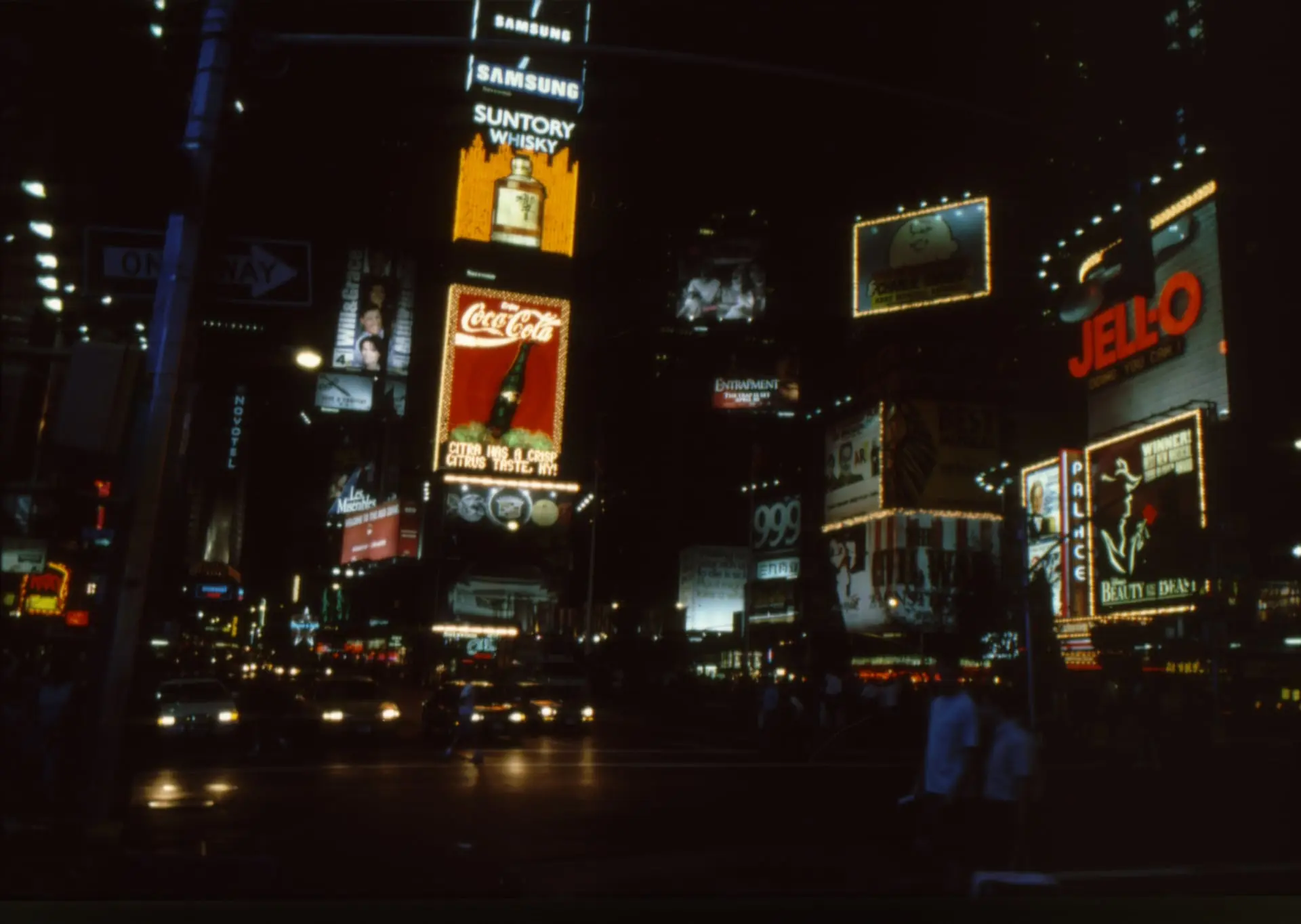
Times Square in May 1999: yellow cabs, neon lights and giant billboards under an overcast skyEsther Westerveld · CC BY 2.0
#ecouter#quad-studios#makaveli#analyze