Close readings
Hail Mary, a Full Reading: the Prayer Turned Inside Out
By Selim Rochat · 9 July 2026 · 13 min read
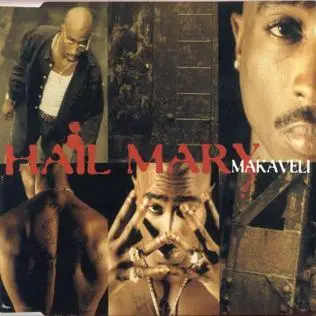
There is one track in Tupac Shakur’s catalogue that resembles nothing else he made, and it may well be the most listened-to of all today. Hail Mary was never a hit in the commercial sense. Released as a single in February 1997, five months after its author’s death, it stalled far below the top of the charts. And yet, three decades on, this is the song rappers quote, the beat battles reach for, the track cinema keeps replaying. What I want to attempt here is what we used to call in school an explication de texte: to walk through the song almost line by line and understand why this dark prayer still haunts everyone.
Makaveli, or the man who signed with a ghost’s name
Some context first. Hail Mary sits near the opening of The Don Killuminati: The 7 Day Theory, the album Tupac recorded at lightning speed in the summer of 1996 and which appeared in November, two months after his murder in Las Vegas. The record does not carry his name. It is signed Makaveli, a pseudonym built on Niccolo Machiavelli, the sixteenth-century Florentine thinker whose treatises Tupac had read in prison. Legend has it that Machiavelli advised faking one’s own death to deceive one’s enemies; that is false, the philosopher never wrote any such thing, but Tupac loved the idea, and the choice of alias fed every theory about his survival. I told that whole story in the Tupac mystery, so I won’t retrace it here.
What matters is the circumstances of production. In the summer of 1996, Tupac is fresh out of a year in prison, he has signed with Death Row Records, Suge Knight’s label, and he is recording at a pace nobody in the industry has ever sustained. The Don Killuminati sessions at Can-Am studios in Tarzana, on the outskirts of Los Angeles, became famous for their brevity: the album’s very title claims a seven-day theory, one week to write and cut an entire record. Hail Mary pushes that logic to its limit. The producer, Hurt-M-Badd, a young man from the Death Row stable for whom this was one of his very first credits, has said he built the instrumental in twenty to thirty minutes. Tupac reportedly wrote his verses in a quarter of an hour and recorded them in a handful of takes. The whole thing wrapped in under an hour. Hold on to that number: everything that follows, this liturgical architecture, this ghetto theology, poured out in a single burst, like something that had been waiting a long time to get out.
The title: the Virgin and the desperation pass
Hail Mary is how the Catholic prayer to the Virgin begins in English, the one recited on rosary beads, the one that closes by asking for her intercession at the hour of our death. A rapper who names his song this way places his text under a religious sky from the first second. But the phrase carries a second, profane meaning that every American knows. In football, a Hail Mary is a last-chance pass: in the dying seconds of a lost game, the quarterback hurls the ball as far as he can toward the end zone, aiming at no one in particular, praying a teammate comes down with it. The play got its name precisely because it belongs to prayer more than to tactics.
The title therefore superimposes two images: the supplication to the mother of God and the desperate act of a man with nothing left to lose. Which is exactly what the song is. Tupac, in the summer of 1996, knows he is being hunted. He has survived a shooting in 1994, he stands at the center of the coastal war I recounted in another article, and he throws this text the way you throw a ball into the night: toward God, toward posterity, toward anyone able to catch it. What happened next gave the gesture an unbearable weight. A few weeks after the recording, he was dead.
The bell before the words
Before following the text, we have to talk about the music, because it does half the work. Hurt-M-Badd builds his instrumental on three elements of total austerity. First a bell, tolling at regular intervals like a church knell, that low peal rung to announce a burial. Then a muffled, almost subterranean bassline, moving in slow pulses. Finally a processional tempo: the track walks, around eighty beats per minute, the cadence of a funeral cortege rather than a party. No catchy melody, no sung sample, almost nothing. That bareness was rare in the rap of 1996, saturated as it was with Californian funk textures and sung hooks. Hail Mary sounds like a crypt.
Over this, the voice. Tupac does not rap here the way he does on his hits. He very nearly chants, in a low register, with that hammered diction that gives every syllable the weight of a stone. And he begins by speaking, not rapping: a recited introduction, half-voiced, that sets the track up as a service.
The opening: an office for the dead
Now let’s follow the text in order. The first seconds are an address. Tupac presents himself as someone approaching the listener, moving toward him, and he specifies his audience: the souls who have gone astray, the ones who got lost along the way. He wonders aloud whether God can still feel tenderness for street criminals, whether heaven keeps a place for those the block has shaped. Then he invites his listeners to walk with him through what feels like a night crossing.
Rhetorically, it’s a captatio of fearsome efficiency. Tupac doesn’t say: listen to my song. He says, in substance: come closer, wandering souls, I will officiate for you. From the outset he takes on the role of the priest, or rather the heretic preacher, the one who says mass for those the official Church has abandoned. The track presents itself not as entertainment but as a rite. And the listener, willing or not, is drafted into the congregation.
Measure the audacity of the move. The rap of 1996 knew God, of course: thanks to the Lord in the liner notes, devout mothers, funerals. But nobody had yet structured an entire song as a hijacked liturgy, complete with a call to the faithful, a knell, responses and imprecations. That hijacking is what makes Hail Mary something other than one more dark song.
First verse: a survivor’s theology
The first verse lays out what I would call Tupac’s personal theology, and it fits into a few propositions. One: he never grants himself full rest, because his enemies are circling and deep sleep is a luxury for the living. Two: he carries his sins as a weight he knows well, claiming no innocence. Three: if God is going to judge him, let God judge with full knowledge of the facts, since it was the world He allowed to exist that made him this way. Four: while awaiting judgment, he answers blow for blow.
Each of these ideas deserves a pause. Paranoia first. Tupac paints himself as a man on watch, anticipating the ambush, living in a state of permanent alert. This was no pose: since the November 1994 shooting in New York, which he blamed on former friends, he genuinely lived that way, ringed by bodyguards, convinced his death was already in motion. I traced that spiral in the article on the betrayals. In Hail Mary, that paranoia becomes poetic material: the world of the text is a world of hostile silhouettes, of shadows closing in, and the narrator moves through it like a condemned man who has decided not to run.
Then the question of sin. Tupac does not ask forgiveness, and that is the decisive point. He acknowledges his wrongs, almost claims them, and turns the accusation back toward heaven: a God who permitted the ghetto, the poverty, the prisons packed with Black men, can that God really sit in judgment of those who clawed their way out through violence? The reasoning runs through all of Tupac’s late work, but here it reaches its most compressed form. The ghetto becomes a theological argument. Forgiveness is no longer something you beg for: it is something you demand, or refuse to request, which amounts to serving God with formal notice.
And then there is vengeance. Because the verse doesn’t stay on the metaphysical heights: it drops back very quickly toward concrete threat. Tupac promises his enemies a grim end, describes the retaliation to come, casts himself as executioner. The slang of the text is that of 1990s Californian streets: adversaries named in gang terms, weapons by their familiar nicknames, the police in the vocabulary of distrust. For the uninitiated listener, let’s simply say that every threat is phrased in the coded language of the neighborhood, which makes it at once more opaque and more chilling, like a trade jargon.
The chorus: the prayer brought down to earth
Then the chorus arrives, the part that gives the track its title. Tupac takes up the opening of the Marian prayer, but grafts an entirely different request onto it. Where the Hail Mary asks for the Virgin’s intercession at the hour of death, Tupac’s chorus asks for something like the strength to make it through one more night, and immediately chains into images of running, of flight, of gunfire. The structure of the response is preserved, the liturgical phrase is recognizable, but the content has been swapped out for the raw matter of the ghetto.
This is the song’s central device, and it needs naming: a detournement. Tupac subjects the prayer to what theologians would call a subversion, and what the street would call a reclaiming. The grandmothers’ prayer, the one recited in church on Sunday, is dragged down to ground level, loaded with gunpowder and fear, and sent back up to heaven in that state. You can read it as blasphemy. You can also read it, and this is where I land, as the most sincere religious gesture there is: praying with what you have, in the language you speak, from the place where you stand. Reread the biblical psalms; they are full of appeals for the destruction of enemies. Hail Mary is an imprecatory psalm with a Los Angeles accent.
The Outlawz: the congregation speaks
After Tupac come his soldiers. The Outlawz, the crew of young rappers he had formed and named himself, giving each one the name of an enemy of America as a provocation, occupy the second half of the track. On the album version, Kastro and Young Noble deliver the verses, while Yaki Kadafi, the closest to Tupac, appears in the track’s margins; the reggae singer Prince Ital Joe lays a floating voice over the ending, like a choir drifting in from another church.
What do the Outlawz say? Essentially, they extend the master’s sermon. Kastro runs with the religious metaphor: he describes himself as a member of a Black and armed confession, evokes baptism by ordeal, communion through loyalty. Young Noble, more earthbound, tells of hustling, of hunger, of streets that manufacture hard men. Their verses are honest without being brilliant, and here that is almost a virtue: after the prophet, the disciples; after the founding voice, the voices that repeat. The track gains a collective dimension from it. It is no longer one man praying, it is a community answering, and the chorus returning between verses starts to feel like a response sung by the assembly.
The detail that chills, in hindsight: Yaki Kadafi, present on the track, would be killed in his turn in November 1996, two months after Tupac, before the single even shipped. The congregation of Hail Mary counted two dead men before the record reached the shelves.
What has to be said honestly
Let’s stop here, because admiration is no excuse for a lack of lucidity. Hail Mary is a song that wraps death threats in a liturgy. Beneath the knell and the Christ-like imagery, the text very concretely promises violence to real enemies, identified transparently for anyone following the coastal war. The beauty of the form must not obscure what the content says: a man announces that blood will flow, and he does so by borrowing the words of a prayer. You can find that sublime, and formally it is. You must also say that it is the sublimation of a vendetta logic that actually killed people, and that ended up killing its author.
I don’t believe we have to choose between the two readings. The song’s power comes precisely from this unresolved tension: Tupac never settles the matter between the penitent and the avenger, between the man asking heaven for a way out and the man loading his weapon. He is both within the same stanza, sometimes within the same sentence. Great moral works are not the ones that deliver the lesson; they are the ones that expose the contradiction without soothing it. Hail Mary lays its contradiction out in the open.
The afterlife: the song that outlived everyone
There remains the strange posthumous career of this song. Released as a single in February 1997, it did respectable radio business without becoming a hit. Then time went to work for it. In 2003, Eminem, 50 Cent and Busta Rhymes took the instrumental and the hook for a track aimed at the rapper Ja Rule, whom they accused of imitating Tupac: hijacking Hail Mary to excommunicate a false prophet, the liturgical irony was complete. The song became a standard for battles and freestyles, one of those instrumentals on which MCs are measured the way pianists are measured on Chopin. Cinema claimed it: John Singleton placed it in Baby Boy in 2001, a film Tupac was to have starred in before his death, and the biopic All Eyez on Me staged it again in 2017. Some even hear in it a distant ancestor of the darkest strains of contemporary rap, those spectral productions where menace is murmured over bells. A debatable lineage, but the mere fact that it gets debated says everything about the song’s standing.
Why this longevity, when far bigger hits from the same era have aged badly? I think the answer lies in everything above. Hail Mary is not tied to its year. No dated sound, no perishable reference in the foreground: a knell, a bass, a voice, death and God. It is a track built from materials that do not go out of fashion, because they have a few millennia of use behind them.
The last Tupac
What does Hail Mary tell us about the man who wrote it in fifteen minutes, a few weeks before dying? This, I believe: that by the end, Tupac was no longer trying to convince, or to seduce, or even to win. The songs of The Don Killuminati, which I walked through in the album guide, are the songs of a man settling his accounts with the earth and opening negotiations with heaven. Hail Mary is the centerpiece of that negotiation. In it you hear a believer who asks no forgiveness, a sinner pleading guilty with extenuating circumstances, a condemned man drafting his own office for the dead.
And that, in the end, is why the song still stares back at us. Most songs about death are written from a distance. This one was written from inside, by someone who was expecting it, over a bell that was already tolling for him. Tupac took the gentlest prayer in the Christian repertoire and reloaded it like a weapon: Hail Mary is a Hail Mary recited with a finger on the trigger, and the trigger spoke first.
#lecture#makaveli#religion