The legacy
Tupac the Sociologist: the Theses Beneath the Songs
By Selim Rochat · 9 July 2026 · 6 min read
There’s a line I repeat to everyone who asks why I spend so much time on Tupac: listen to him the way you read a field sociologist. Not a doomed poet, not a mythologized gangster, not a martyr. An observer who spent twenty-five years immersed in his object of study, and who drew theses from it. They are written down nowhere in treatise form. They live in the songs, and this site exists in large part to extract them. Here is my attempt to lay them out flat.
First thesis: violence is an inheritance, not a choice
Let’s start with the most misunderstood: Thug Life. The tattoo has been read as an outlaw’s profession of faith. It is exactly the opposite. In his usage the expression works as an acronym, and the idea it unfolds is chilling in its rigor: the hatred a society instills in its children eventually comes back on everyone. It is a theory of transmission. The despised child, badly housed, badly schooled, does not vanish; he grows up, and he pays back what he was given. Ghetto violence is not a pathology of the poor, it is the deferred product of negative social investment. The sociologists of reproduction said nothing different, just with footnotes attached. He said it in two words tattooed across his stomach, and the group album Thug Life Volume 1 is that idea set to music. I gave an entire article to this misreading and to the genesis of the 1992 code, what the phrase meant to Tupac.
Second thesis: prison manufactures what it claims to punish
As early as 2Pacalypse Now, he describes the war on drugs for what it is: a machine for incarcerating young Black men, grinding them down without ever touching the causes. He tells the stories of characters trapped between constant police control and the total absence of economic alternatives, and he traces the circle: arrest, record, exclusion from legal work, return to dealing, reincarceration. When he passes through prison himself in 1995, the intuition becomes experience. He comes out convinced that the institution rehabilitates nothing, that it hardens, that it recruits. Here again, research vindicated him years later, recidivism statistics in hand.
Third thesis: structural abandonment has a face, and it belongs to a teenage girl
Brenda’s Got a Baby may be the closest he ever came to a monograph. A twelve-year-old girl, a pregnancy, a family that fails her, institutions nowhere to be found, a fall. At no point does he judge. He unspools a causal chain: poverty produces ignorance, ignorance produces early pregnancy, the absence of any safety net produces catastrophe. And at the end he widens the frame: what happens to Brenda happens to the whole community, because a society is measured by what it does with its most fragile members. It is a case study in the strict sense, one individual chosen to make a structure visible. I say more in my page on the 1991 album, but I stand by this: the song deserves a place on social science syllabi.
Fourth thesis: the condition of Black women is the measure of everything else
Keep Ya Head Up, in 1993, asks a question the rap of its day carefully avoided: how can men born of women hold women in contempt? In it he stands up for single mothers, for women abandoned by the fathers of their children, for those insulted in the very songs that celebrate the street. The contradiction with other parts of his catalogue is real, and I won’t airbrush it. But the thesis itself is crystal clear: a community that mistreats its women destroys itself, because they are the ones holding everything upright while the men are in prison, in the cemetery, or on the run. The son of a single mother, he knew what he was talking about.
Fifth thesis: dealing is a rationality, not a vice
This is probably his most unsettling point for the comfortable listener. Tupac refuses to treat drug dealing as moral deviance. He describes it as an economic decision made in a space where legal options pay less than the survival threshold. When the school is in ruins, jobs don’t exist and the rent comes due anyway, selling becomes a calculation, not a sin. Call it a survival economy. He doesn’t glorify the choice; he shows its cost, the deaths, the fear. But he demands that we understand it before condemning it, and that demand is precisely the posture of a sociologist.
Where the gaze comes from: the Panther inheritance
None of this comes out of nowhere. His mother, Afeni Shakur, was a leading figure in the New York Black Panther Party, acquitted at the end of one of America’s great political trials. His stepfather Mutulu, his godfather, his aunt: the entire family constellation comes out of Black revolutionary militancy. Tupac grew up in a house where capitalism, structural racism and state violence were analyzed over dinner. His theses are the Panther inheritance filtered through a generation that watched the movement get destroyed and crack arrive. Where the Panthers offered a program, he records the rubble. That is what gives his gaze the hopeless lucidity that peaks on Me Against the World.
Justice as a demand, not a doctrine
There remains the thread running through it all: a sense of justice that never hardened into a system. Tupac proposes no ideal society. He keeps a ledger of wrongs. And that ledger was fed by his own experience of betrayal: the 1994 trial, the Quad Studios shooting, the friendships lost, everything I recount in the article on the betrayals. For him, injustice is not a concept, it is a burn inflicted over and over, by the state and by those closest to him alike. Hence the permanent oscillation between the plea and the revenge, which makes his work moral without ever being moralizing.
A thinker without a system
Let’s be honest about it: Tupac contradicts himself. He celebrates what he denounces, threatens those he mourns, changes position from one album to the next. He is not a theorist, and anyone looking for a coherent doctrine in his work is wasting their time. But the theses, taken one by one, hold up. Violence as inheritance, prison as factory, structural abandonment, the centrality of women, dealing as rationality: thirty years on, every one of them has been confirmed by people with degrees who never listened to him. That is why I keep reading him as a thinker. Without a system, yes. But with ideas that outlived their author, which is the only serious definition of a body of work. To hear these theses in order, my guide ten tracks to understand him was built for exactly that.
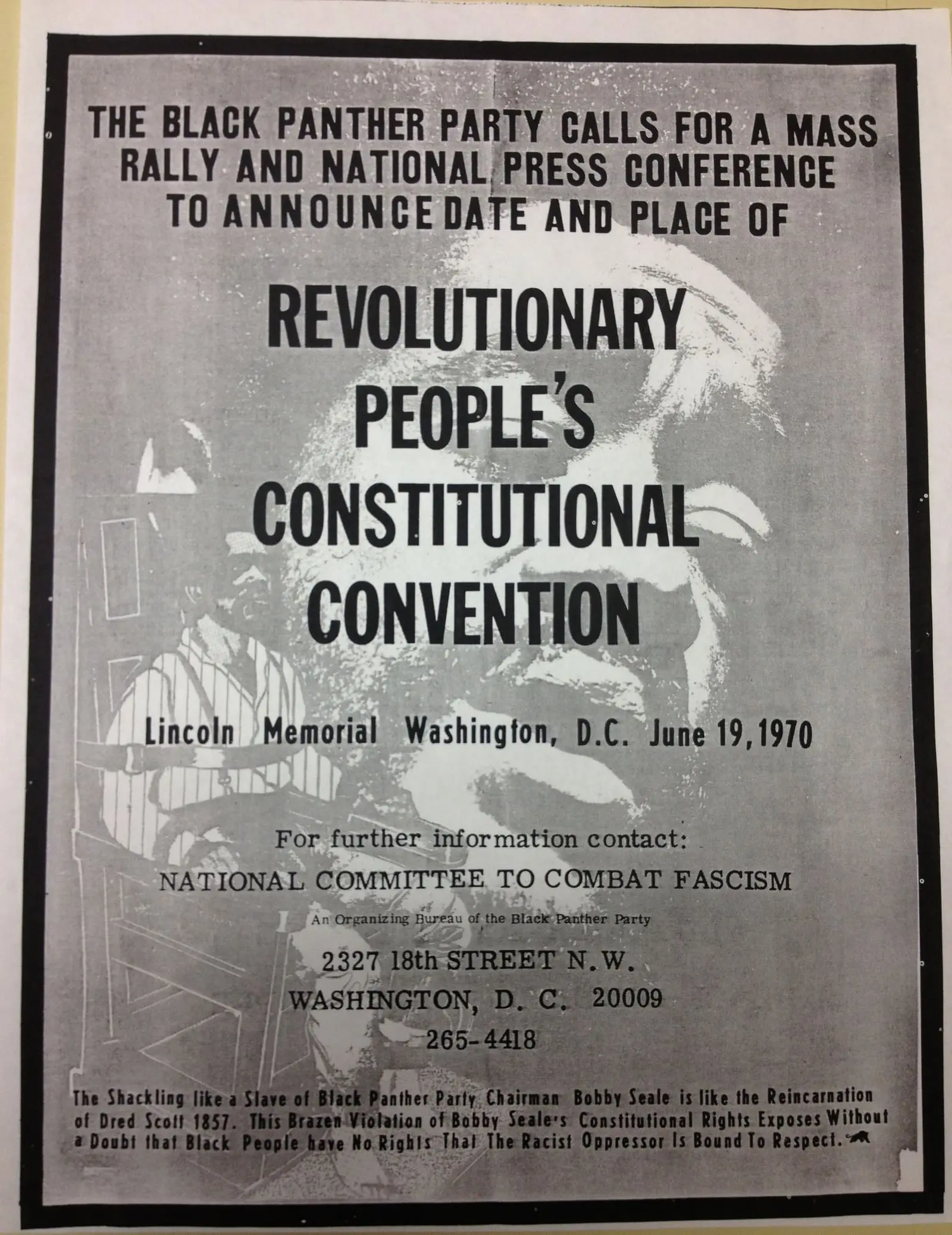
Period flyer calling for the Black Panther rally of June 19, 1970 at the Lincoln Memorial in Washington, militant black-and-white typographyNational Committee to Combat Fascism · domaine public
#heritage#thug-life#black-panthers#analyze