The legacy
Thug Life: What the Phrase Meant to Tupac
By Selim Rochat · 28 September 2026 · 5 min read
Type “thug life” into a search engine and you get pixelated sunglasses and a man who misjudges his jump. The phrase has become a rallying sign of online humor, a synonym for swagger, sometimes for bravado. It went around the world and lost along the way almost everything Tupac Shakur had put into it. The tattoo he wore across his stomach, in big capital letters, said something else, and that something deserves a pause, because it sits at the heart of his work.
The common meaning, and the misreading
In everyday use, a thug is a hoodlum, so thug life would be the hoodlum’s life, embraced with flair. There is nothing absurd about reading the two words that way: Tupac played on that ambiguity himself, and on some records he staged a violence that needs no commentary. But turning the phrase into a simple celebration of crime means ignoring the sentence he offered as its key, interview after interview. According to him, THUG LIFE was an acronym: The Hate U Give Little Infants F***s Everybody. The hate you give children comes back on everyone.
That sentence turns the word around. The thug is no longer an aesthetic choice or a fate at birth, but a product. Children are left in neighborhoods without schools, jobs or protection, they learn that society owes them nothing, and then everyone is surprised when they grow up armed. Tupac is not making an excuse. He describes a chain of causes and announces that the bill will be collective. It is the same thesis I unfold in my piece on Tupac the sociologist, where violence is reproduced from one generation to the next like an inheritance nobody asked for.
Where the idea comes from
You have to remember who raised him. His mother, Afeni Shakur, was a member of the Black Panther Party, tried and then acquitted in a trial that remains famous in the movement’s history. His stepfather, Mutulu Shakur, was also an activist, and was in prison at the time. Tupac grew up in a home where urban poverty was discussed as a political problem, in the vocabulary of leaflets and courtrooms. When he became famous, he carried that upbringing into a different language, that of records. Thug Life is that translation: a social program run through the filter of the street.
Tupac understood that a slogan legible on a body travels faster than a speech. He made it an identity, then the name of a group. The risk was known: a simple sign invites further simplification.
The code of 1992
The least known episode is the most serious. In 1992, Tupac and Mutulu Shakur are said to have written together what is known as the Thug Life code, a text of more than twenty rules meant for gangs. The idea is simple and almost disarming: if the war of the streets cannot stop overnight, its damage can at least be limited. Do not target civilians, do not involve children, do not turn neighborhoods into hostile ground for the people who live there. According to accounts, the code was presented at a gathering of the gang truce in California.
You can find the project naive, and it partly was. A text, however well meant, does not disarm rival armed organizations, and Tupac himself did not always live up to his own charter. But the ambition says a lot about him. Behind the outlaw pose was someone trying to organize the street from the inside, to give it rules instead of fleeing it or glorifying it. It is the gesture of a child of activists. He had not renounced his mother’s legacy; he translated it into the language of his age.
The sound of it
The name became a group in 1993, around Tupac, with Big Syke, Mopreme Shakur, Macadoshis, The Rated R and Randy Walker, known as Stretch. The collective’s only album, Thug Life: Volume 1, came out on September 26, 1994 on Interscope and climbed to number 42 on the Billboard 200. It is not Tupac’s best-known record, nor his most polished, but it keeps the memory of a period when the idea of a code and the idea of a group were one. Tupac’s imprisonment scattered the group in 1995, Stretch was killed in November of that year, and some of the survivors, Big Syke among them, would later join the Outlawz.
To hear what this philosophy becomes when it meets reality, you have to follow the rest of the path. The betrayals of 1994 to 1996 show what real violence does to a project of peace: the dream of a code disappears under gunfire, and the tone of the records changes with it. That is one reason Thug Life cannot be reduced to a slogan. It is also the story of a failure, and that failure belongs to the same history.
From tattoo to meme
Thirty years on, the phrase has escaped its author. It captions videos of comic bravado, names clothing lines, works as a password among friends. An expression that survives its context this thoroughly must have touched something. What it lost, however, is the second meaning, the one that forced you to look at who manufactures thugs. The meme keeps the pose and throws out the analysis. Tupac’s influence on rap can also be read in this spread, with its losses.
How to hear it today
If you want to hear Thug Life differently, start by rereading the acronym before you press play. Then listen to a track where violence is described from the inside, without glorification, like the one I analyze in the reading of Brenda’s Got a Baby, where a child becomes a mother amid general indifference. The line from that text to the tattoo is almost straight. To place the term in its original vocabulary, the matching entry in the Tupac glossary gives the useful references.
One thing is easy to forget: Thug Life is neither an innocent slogan nor an apology. It is a sociologist’s thesis carried by a twenty-year-old, with its excesses and blind spots, and the story of how it was received says as much about us as about him.
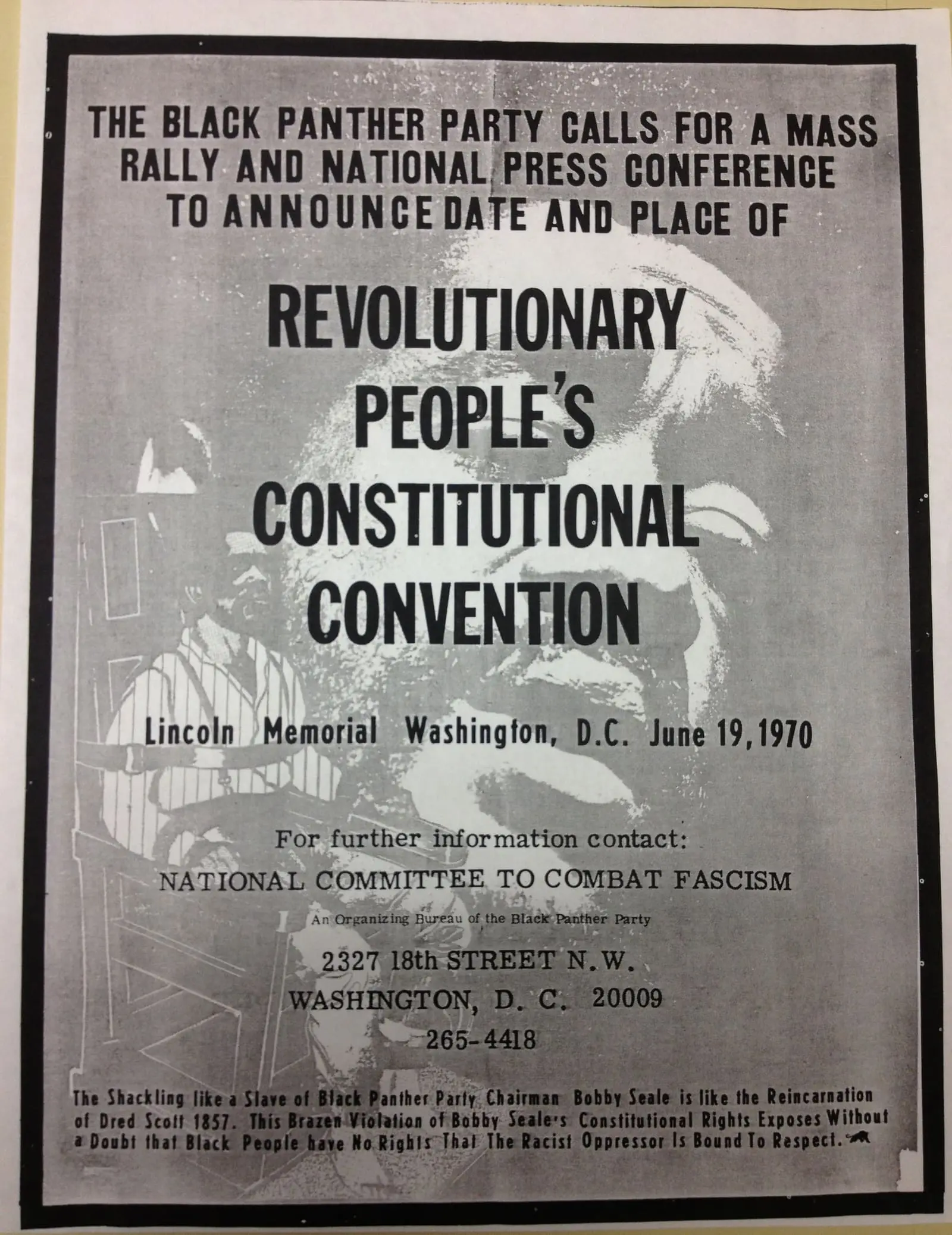
Period flyer calling for the Black Panther rally of June 19, 1970 at the Lincoln Memorial in Washington, militant black-and-white typographyNational Committee to Combat Fascism · domaine public
#thug-life#signification#philosophie