Close readings
I Ain't Mad at Cha, a full reading: an elegy for damaged bonds
By Selim Rochat · 9 July 2026 · 20 min read
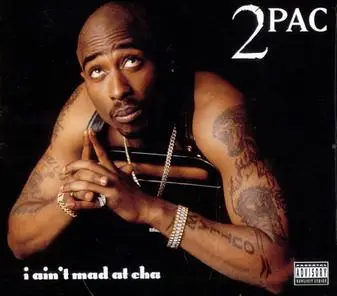
I Ain’t Mad at Cha is one of the most ambiguous texts Tupac Shakur ever wrote. On first listen, the track sounds appeased: the hook keeps repeating that he holds no grudge against those who changed. But this absence of rancor is not a simple peace. It is a hard melancholy. Tupac watches friends, lovers and intimates drift away from him, or be transformed by prison, religion, money, crime, fame and survival. He does not condemn them head-on. He observes. He understands. He suffers. Then he lets them go.
The track belongs to All Eyez on Me, the album released in 1996 after Tupac’s release from prison and his signing with Death Row Records. The song was produced by Daz Dillinger, with Danny Boy on the hook, and builds on an interpolation of A Dream by DeBarge. It grew even more unsettling because the single came out in September 1996, shortly after Tupac’s death, and because the video shows him gunned down, dying, then watching the living from the beyond. That coincidence of fiction, video and real death gave the track an almost prophetic funeral aura. The album’s title track also has its own full reading, worth setting beside this one.
The title: three movements in one formula
The title itself is essential. I ain’t mad at cha means: I hold nothing against you. But the formula is neither pure Christian forgiveness nor indifference. It contains three movements at once. First: I saw that you changed. Second: that change pulled you away from me. Third: I will not hate you for trying to survive. The track is therefore a meditation on diverging paths. Some leave the ghetto through religion. Others through love. Others through money. Others through crime. Others through fame. But no path leaves a person intact.
The intro sets the theme of change straight away. Tupac concedes, in essence, that transformation may do anyone good, above all if it gets you clear of the neighborhood. The word hood names the working-class district, often Black, poor, surveilled, violent, saturated with police, drugs, hustling and confinement. Getting out of the hood is a victory, but an ambiguous one: whoever leaves can be accused of betraying those who stay. Tupac refuses that easy accusation here. If someone manages to get out, to transform, to dodge death or prison, hatred is not the required response. Hence the central sentence: he holds no grudge.
Yet Tupac’s voice is not serene. Absence runs through it. He speaks to friends he hasn’t seen in ages. Word reaches him that they’re still stirring things up, still moving through the streets, still existing somewhere else, without him. The intro reads like a dedication sent across a distance. The track opens, in other words, as an open letter to people who shared the past but no longer share the present.
First portrait: the street brother who became a Muslim
The first verse tells the story of a former little street brother who became a Muslim after prison. For an uninitiated reader, the frame needs explaining. In the United States, in poor Black neighborhoods, Islam in its various forms has often served as discipline, dignity, moral rebuilding and a symbolic exit from the street. For some men who have been through prison, religious conversion becomes a way to break with drugs, women, guns and the criminal identity.
Tupac begins by recalling that he and this friend were once cut from one cloth. They worked identical routines on girls, moved through the same world, shared the same codes of seduction, street and provocation. The idea of being of one breed matters: they were not merely close; they belonged to the same social species. They recognized each other by instinct.
Tupac then notes that the other was smaller, younger, yet already rolling with them. The verb roll means to accompany, to belong to the group, to be part of the action, to take part in street life. The young friend was not yet fully formed, but he already carried the codes. The street had already absorbed him.
The reference to Y.A. most likely points to the Youth Authority, an institution for juvenile offenders, a form of prison or detention center for minors. The friend is sent there, then comes back physically transformed: stronger, bulked up, harder. Tupac is describing a brutal rite of passage. Street childhood leads to confinement; confinement produces a harder body; that body returns to the neighborhood with a new authority.
The details that follow are very concrete: the Jheri curl, the Glock, the sherm. The Jheri curl refers to a hairstyle popular in certain African-American communities in the 1980s and early 1990s. The Glock is a handgun. Sherm names a drug, often a cigarette or joint dipped in PCP or a similar substance, associated with states of disinhibition and confusion. Tupac is painting the old friend before his transformation: young, armed, intoxicated, prisoner of a style and a neighborhood.
The turning point comes with the phone calls from prison or from a distance. The friend says he has changed. He has become a Muslim. He no longer deals drugs. He wants to attend the mosque. He is done chasing women. For Tupac, this is a rupture. The little brother is no longer the same man. He has traded the street game for a religious discipline.
Tupac’s reaction is double. On one side, he registers the loss of his little homie. Homie means a close friend from the neighborhood, a street brother, a companion of the same milieu. On the other, he recognizes that this transformation may be a victory. The friend went through prison and now wants to sin no more. The prison that could have destroyed him produced a moral reform instead.
The contrast between the two men becomes plain when Tupac talks money and success. He thinks in terms of material achievement, of living large, of wealth, of motion. The converted friend sees struggle, danger, moral trouble. This is no longer a mere difference in lifestyle. It is a difference in worldview. Tupac remains drawn to expansion, money, power; the other seeks purification and stability.
Tupac then congratulates his friend on his marriage. Marriage here marks the entry into an ordered life. But he adds, with humor and lucidity, that the wife should understand something: the street kid’s old player instincts won’t ever fully die, and she ought to know it. The past never disappears entirely. Conversion, marriage, the mosque, none of it erases the whole former identity. Tupac acknowledges the transformation, but he knows the street boy survives beneath the religious man.
The mention of the sister is quintessential Tupac: intimate, sexual, almost embarrassing, but also nostalgic. He remembers wanting his friend’s sister without ever crossing the line. That detail summons a whole adolescent world: attractions, taboos, intertwined families, the houses of the neighborhood, desires held in check. Tupac’s memory is never abstract. It moves through bodies, places, longings.
He then remembers the after-school outings, the fights against whoever wore the wrong markers or said the wrong thing. This is violent childhood, but fraternal childhood too. Violence is not yet purely criminal; it is a language of belonging. The kids defend, attack, prove to one another that they stand together.
Then comes the plain statement: everything changed, and they no longer see each other. Tupac now carries big money plans, but the old friend is no longer beside him. Change has created a practical distance. They are not enemies, but they no longer move forward together. It is one of the subtlest themes in the track: estrangement without hatred. Betrayal is not always the cause. Sometimes lives simply stop being compatible.
The end of the first verse is affectionate. Tupac declares his certainty that, underneath, the other remains the same man, the one who would plant himself at his shoulder if everything collapsed. That nuance is decisive. Religious change does not erase fundamental loyalty. The friend no longer hangs around, no longer joins the schemes, no longer shares the same appetites, but he remains a potential brother in the hour of trial. That is why Tupac holds nothing against him.
Danny Boy’s hook is brief, soft, almost liturgical. It repeats the title’s formula. That softness is essential. It keeps the track from becoming merely narrative or bitter. The sung voice introduces a form of consolation. Where Tupac recounts the separations, Danny Boy supplies the sentence that makes them bearable.
Second portrait: love and prison
The second verse changes addressee. It speaks to a woman, probably a former companion or partner, tied to the years of youth and incarceration. Tupac recalls that the two of them were like kin perched at the far edge of the family tree: close without truly being family, bound by the neighborhood, the quarrels, the games, the daily familiarity. The image is strong because it blurs love, friendship, family and neighborhood. In the hood, relationships don’t always sort into clean categories.
He evokes the arguments, the crude jokes, the rooftops, the stairwells, the moments when they hid, smoked, wanted each other, killed time. The text rebuilds a geography of poor adolescence: rooftops, staircases, hidden corners, unofficial places. These are not bourgeois living rooms, cafés or sheltered bedrooms. They are in-between, semi-public spaces where loves and complicities take shape.
The verse then admits that, beyond sex and desire, not much occupied their minds. Time passed, and a life of crime became the thing they were taught to live. The formulation is blunt. Crime is presented not as a romantic vocation but as a pedagogy. You learn to live that way because the environment teaches it. Childhood tips into delinquency almost naturally, without any grand moment of decision.
Tupac then asks for time to be spooled backward. In a song of memory, that gesture is essential. He wants to return to the era when they were too young to grasp what they were doing. The backward glance is not innocent: it shows that crime, sexuality and prison all arrived too early. Children were placed in adult situations before they had the means to understand them.
He then recounts the arrest and the sentence. He is hit with a felony, meaning a serious criminal offense. And yet he admits a pull toward the sound and force of firearms. That contradiction is pure Tupac: he knows violence destroys, but he also acknowledges its sensory, aesthetic, virile appeal. The text does not moralize in a simple way. It shows the fascination and the cost.
The separation scene with the woman is raw and painful. Tupac leaves for prison and asks her to keep herself for him sexually. He wants to hold on to his bond, his love, his possession. The line is stamped with male jealousy and fear of abandonment. Incarceration cuts the body off from the world; the prisoner can no longer control what happens outside. The sexual demand becomes an attempt to remain present despite the absence.
The scene with the mother is graver. Tupac kisses his mother, dries her weeping, promises he will come back, but he must leave to face what waits for him. The loneliness written on her face is the detail the verse lingers over. It is one of the moments where the track joins Tupac’s great elegiac vein, the one running through Dear Mama. The mother is a central figure in his work: suffering, beloved, witness to the damage inflicted on her son. Here, incarceration is not merely an individual punishment; it is a wound imposed on the family.
When he admits that no happiness exists for him in that place, he means the prison, but also, more broadly, the world that holds him. He is not happy in confinement, in the fate that led him there, in the violence that formed him. Prison takes the smiles away for years at a stretch. The formula is simple but devastating: the institution steals time, youth, joy.
In his cell, he loses his grip, fights, thinks about the return. The text describes incarceration as suspension and fermentation. The body is locked up, but the mind is already preparing the exit. Prison does not necessarily pacify; it can intensify rage, sexuality, loyalty, plans for revenge or return.
When he imagines his release, his first thought goes to the woman who waited. The language turns sexual, direct, almost brutal. But in the verse’s logic, that sexuality also means a return to life. After confinement, finding the other’s body again becomes proof that you still exist. Desire is a revenge against the cell.
Friends also want to see him when he gets out, but Tupac laughs and repeats that he holds nothing against her. Here the hook addresses the loyal woman, the one he calls down-ass, meaning profoundly faithful, ready to hold on, attached to him despite prison. The term is vulgar, but it names an absolute loyalty. The second verse thus celebrates another form of change: love that survives absence, or at least the image of a love that might have survived.
Third portrait: the one who rises
The third verse shifts perspective again. This is no longer the brother turned religious, nor the woman tied to prison. This is the one who made it, who climbed, who became rich or famous, but whom the climb cut off from the others. This third character can be read as a double of Tupac himself as much as a former friend. That is what makes the verse complex.
The opening describes a man rising socially. He earns money, draws women, wears jewelry, goes from nothing to plenty, from nobody to local figure. To understand the passage, you need to grasp the importance of visible success in 1990s rap: jewelry, cars, neighborhood reputation, cash, women, status. Poverty being a humiliation, the display of wealth becomes a way of reclaiming control over one’s own image.
But this success is ambiguous. The man becomes a local celebrity while remaining tied to the drug trade. Ki’s means kilos, most likely of cocaine or another drug moved in bulk. Social mobility, then, runs through crime. He has left the bottom rung, but not the system of violence. He has gained luxury, not necessarily freedom.
Tupac then says this man was first one of their own, but that his evolution forced a choice. The sentence is harsh. It shows that ascent can open a lethal fracture. In the world being described, succeeding does not simply mean leaving. It can mean becoming a target, a rival, a traitor or a threat. Success draws admiration, but hatred too.
The verse then touches the violence aimed at the one who changed. He is to be killed while weakened or intoxicated. The text does not dress this up as noble. It shows a street logic where old affiliations can flip into execution. The man who was one of theirs can become the man to eliminate. It is a very dark vision of social mobility: to rise is to expose yourself.
Tupac returns to a youth full of pain, to guns going off, to drugs used to keep some faith in the future alive. This formula is typical of his art. Drugs are not only pleasure; they are anesthesia. You get high because the future weighs too much. You keep believing tomorrow might improve, but you believe it surrounded by guns and crime. The hope is not pure. It is contaminated by despair.
The line about crime paying is deliberately murky. It can be read as cynical observation: in certain worlds, crime seems to pay faster than legal work. But Tupac knows this payment carries a price. Criminal money buys jewelry, cars, status, and also paranoia, prison, betrayal, death.
He then says that many turned against him, that many tried to scheme. This is one of Tupac’s great post-1994 motifs, the one I trace in the piece on the betrayals: paranoia. He sleeps with a weapon within reach of his head. Success has not soothed him. It has made him more of a target. The higher he climbs, the more he must protect himself. Success is not the exit from danger; it is another form of it.
The question of when it will stop is central. It introduces a deep weariness. Behind the hard posture, there is exhaustion. Tupac is not only asking who stands against him; he is asking when this logic will end. The implicit answer is terrible: perhaps only when God restores him to what he originally was, that is, when he dies or returns to a first state. Peace seems located beyond life.
There is a striking line built on the memory of his teenage years and his refusal, even then, of the convalescent condition. A convalescent is someone recovering from illness or injury. Tupac says that as an adolescent he already rejected weakness, passivity, the sick-bed role. He would not be treated as an ailing body. He wanted to act, attack, live at full intensity. But that strength is also a curse: never accepting vulnerability means condemning yourself to permanent armor.
The end of the third verse answers an accusation common in rap: when someone leaves the ghetto, gets rich or famous, some say he is no longer real. Being real, in this context, means staying authentic, faithful to the street, faithful to your origins, faithful to your people. Tupac puts the question bluntly: does leaving the ghetto strip a man of his realness? That question runs through his entire body of work.
The track’s answer is not simple. Tupac rejects the idea that success equals betrayal. But he also knows that success transforms relationships. Those who stay may read the departure as distance, arrogance, lost loyalty. The one who leaves may feel judged, envied, threatened. I Ain’t Mad at Cha is precisely the song of that tension: leaving without hating those who remain; staying faithful without staying captive.
Three portraits, three forms of change
The final hook repeats the formula until it becomes almost a prayer. Holding no grudge becomes a way of surviving the separations. It is not a naive sentence. It is a sentence of mourning. Tupac is not saying all is well. He is saying that things change, that people drift, that loyalties shift, that prison, money, religion and the street break the old brotherhoods, but that he refuses to convert every estrangement into hatred.
The great strength of the track is its structure in three portraits. First portrait: the street friend turned Muslim, seeking a moral exit. Second portrait: the woman or love tied to youth and prison, embodying affective loyalty. Third portrait: the one who rises socially, earns money, becomes famous or powerful, and finds himself accused of having changed. These three portraits correspond to three forms of transformation: conversion, fidelity through absence, ascent.
These three forms of change also match three great Tupac themes. Religion as an attempt at purification. Love as fragile refuge against prison. Success as poisoned victory. In all three cases, change is never simple. It saves and it separates. It lifts and it isolates. It protects and it betrays something of the past.
The poetry of the track lies in its refusal of final judgment. Tupac could have written a text of reproach. He could have said: you changed, you abandoned me, you are fake. He does not, not entirely. He looks at the changes with a wounded lucidity. He understands that everyone is looking for a way out. Even when the way out creates distance, even when it renders someone unrecognizable, he grants them the right to try to survive.
Musically, the track’s softness does crucial work. The DeBarge-inspired piano, Danny Boy’s soul voice, the unhurried tempo: everything builds a space of remembrance. Tupac does not shout the way he does in Hit ‘Em Up. He narrates. He lets the images drift back. The violence is there, but wrapped in a melody that is almost tender. That contradiction is the track’s greatness: the text speaks of prison, drugs, guns and betrayals, and the music gives it all the color of regret.
The exact inverse of Hit ‘Em Up
I Ain’t Mad at Cha is thus the exact inverse of a track like Hit ‘Em Up. In Hit ‘Em Up, the wound becomes attack. In I Ain’t Mad at Cha, the wound becomes memory. In Hit ‘Em Up, the other’s change is experienced as a betrayal to punish. In I Ain’t Mad at Cha, change is accepted as a condition of survival. In Hit ‘Em Up, speech wants to destroy. Here, it tries to let go.
That does not make the text morally pure. The track still carries sexist language, fantasies of possession, macho codes, the pull of crime, street pride. Tupac does not magically step outside his world. But he introduces a rare nuance into it. He accepts that loyalty does not always mean staying identical. He accepts that growing up, converting, marrying, leaving prison, making money or leaving the neighborhood can create distance without cancelling the old love.
For a reader who knows nothing about Tupac, I Ain’t Mad at Cha is an excellent entry point, because it displays his principal gift: holding social brutality and intimate tenderness inside a single song. Tupac is never only a gangster, never only a poet, never only a victim, never only a star. He is the writer of a world where love and violence share the same staircases, the same rooms, the same cells, the same memories.
The posthumous letter
The track is, in the end, an elegy for damaged bonds. It mourns not only the dead. It mourns the living who have grown distant. The religious friend is alive, but no longer the same. The beloved woman is alive, but separated by prison and time. The one who succeeds is alive, but ringed by suspicion. The past itself is alive, but out of reach.
The title’s formula then becomes one of Tupac’s most mature sentences. It does not mean the pain is absent. It means the pain will not be turned into condemnation. It is a word of restraint in a body of work so often ruled by excess. It says: the world changed us, sometimes damaged us, sometimes pulled us apart; but the memory of what we were together deserves better than hatred.
The track remains overwhelming because, after Tupac’s death, it was heard as a word of farewell. Even though the text never speaks explicitly of his own death, it seems to watch the living from a place of separation. The video reinforced that reading by showing Tupac dying, then observing his friend from the beyond. After September 1996, the song was no longer merely a track about distant friends. It had become, in spite of itself, a posthumous letter.
I Ain’t Mad at Cha is therefore a work of transition, memory and mourning. It says that people change because they must survive. It says the street produces intense loyalties, but rarely stable ones. It says that prison, religion, love, crime and money alter souls. Above all, it says there exists a form of love lucid enough not to demand that the other remain identical.
In Tupac’s poetry, this is an essential moment. Not complete peace, but hatred held in suspension. Not pure forgiveness, but the refusal of rancor. Not innocence, but a tenderness that has crossed too much violence to be naive. I Ain’t Mad at Cha is the song of a man who knows everything changes, who suffers for it, and who understands that some changes are the price of survival.
#lecture#all eyez on me#élégie