Close readings
2 of Amerikaz Most Wanted, a full reading: the party under warrant
By Selim Rochat · 9 July 2026 · 21 min read
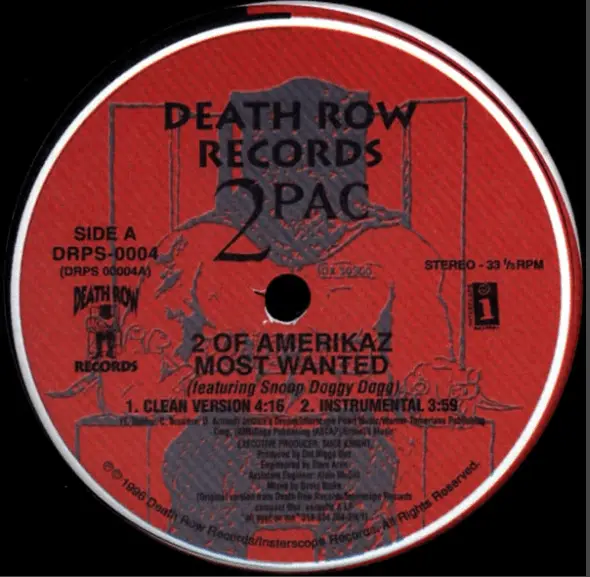
2 of Amerikaz Most Wanted is a track about walking out of prison, about judicial triumph and public provocation. Tupac Shakur and Snoop Doggy Dogg appear on it as two men whom American justice, the media and the music industry turned into figures of danger. The title does not only mean two of the most wanted men in America. It means: two famous Black men, criminalized, surveilled, enriched, accused, acquitted or released, gathered in the same studio, on the same label, at the same moment, and determined to make a spectacle of the situation.
The track belongs to All Eyez on Me, the 1996 album through which Tupac returns from prison and cements his new alliance with Death Row Records. 2 of Amerikaz Most Wanted brings together Tupac and Snoop Dogg, two central figures of the West Coast, over a Daz Dillinger production. The title was recorded in October 1995, shortly after Tupac’s release, and issued as a promotional single in 1996. The video, directed by Gobi M. Rahimi, sharpens the track’s theatrical dimension by staging a parody of Biggie and Puff Daddy built around the 1994 shooting of Tupac. The track also carries interpolations of The Message by Grandmaster Flash and the Furious Five and of Radio Activity Rap by MC Frosty and Lovin’ C.
The context: two judicial trajectories
The context is indispensable. Tupac walks out of prison on October 12, 1995, after Suge Knight, head of Death Row Records, arranges his release on bail in exchange for a contract with the label. Snoop Dogg, for his part, has just been acquitted in a murder case in February 1996. These two trajectories sit at the heart of the track: two rap stars, both tied to criminality by the courts, the media and the public imagination, convert their proximity to prison into arrogant celebration. The track does not merely say: we are free. It says: you tried to lock us away, and we return more visible, richer, more dangerous in the symbolic order.
The intro opens like a cell door swinging and a party beginning. Voices laugh, light something up, set a mood of jubilation. The repeated line of the hook sets the tone: what’s happening here, it insists, is a gangsters’ celebration and not one thing more. This is not a respectable ceremony. It is not a press conference after an acquittal or a release. It is a gangsters’ party, owned as such. The track converts legal freedom into an imagined criminal festivity.
When Tupac marvels that someone put two of America’s most hunted men in one room at one time, he dramatizes the reunion. He is not talking about two artists guesting on a song. He talks as though the state had committed a tactical error: gathering two men the system wanted contained. The studio becomes something close to an escape scene. The song is born of that fiction: America wanted them separated, watched, judged; Death Row unites them and makes an event of it.
The toast to the gangsters matters. A toast is normally a gesture of social celebration, sometimes elegant, almost worldly. Here it is raised to gangsters. Champagne, condoms, laughter, marijuana, threats and luxury furnish a single decor. The track blends the signs of success with the signs of criminality. This is the Death Row aesthetic at its peak: money, provocation, sex, court cases, guns, West Coast, G-funk, laughter in the face of danger.
The first verse: painting an image
The first verse opens with a painting image. Tupac announces that he is composing a flawless scene. It is a meta-poetic entrance: he declares that he is constructing a tableau. The rapper is painter, director, manufacturer of icons. But the image he paints is not gentle. It is made of sexualized women, predatory precision, money, masculine loyalty and judicial danger. The beauty of the canvas comes from its aggressive shine.
He immediately couples his sexual ambition to his economic one. He wants to reach women with a hunter’s accuracy and to grow richer. The formulation is hard, sexist, typical of the track’s gangsta persona. Women appear not as subjects but as signs of power and pleasure. In this verbal economy, seducing or possessing women confirms masculine status, while money remains the central objective.
Snoop’s arrival is announced through his name delivered letter by letter. That installs Snoop as a brand, an instantly recognizable sonic character. Snoop Dogg, revealed by Dr. Dre and Death Row, embodies another form of Californian power: more nonchalant, more fluid, more phlegmatic than Tupac, but equally tied to gangsta rap, to a trial, to celebrity and to the street. Their pairing creates an effective contrast: Tupac burns, Snoop glides.
The reference to hogs, meaning motorcycles or big-engined machines, folds Snoop into an image of mobility and dominance. The track is full of vehicles: luxury cars, a Benz, a Regal, a BMW. Freedom here is constantly motorized. Leaving prison, leaving the neighborhood, rolling with the camp, evading police, arriving at court, heading to a show: everything moves on wheels. The vehicle becomes a symbol of liberty, and of flight.
Tupac then explains that his fist stays wrapped around a pistol because pursuit was forced on him. The idea reworks a logic already present in The Message by Grandmaster Flash: armed because others put him to flight. What matters is the reversal of responsibility. Tupac is not merely saying he carries a weapon. He is saying the world made him carry it. The system, the enemies, the trials, the envious, the police placed him in this state of permanent defense.
The courtroom appears at once. Tupac finds himself before a judge again, a verdict still pending. Understand that Tupac’s life in this period is saturated with procedures, criminal cases, accusations, bail, prison and surveillance. The courtroom is not an isolated episode; it becomes a recurring set of his existence. Stardom has not lifted him out of the judicial system. On the contrary, his celebrity makes his cases more visible.
The support slogan Free 2Pac recalls the mobilizations during his incarceration. For his fans and intimates, Tupac is not merely an inmate; he is a figure unjustly seized by the system. But in the track he adds that while some are working on his freedom, others appear to want his life. Legal liberation, then, is not enough. Even outside, he feels hunted. Prison is only one form of capture among others.
He then announces that he intends to grow smarter and more defensive. The line matters because it shows the gangsta posture is not purely impulsive. Tupac presents his violence as strategic adaptation. He has learned. He will protect himself. He will organize. Defense becomes almost political.
The reference to a million-strong march for gangsta business most likely bends the imagery of the Million Man March, the great African-American mobilization held in Washington in October 1995 around responsibility, dignity and the unity of Black men. Tupac twists that collective, political reference into a gangsta version, more provocative, more cynical, more aligned with Death Row. The line is deliberately insolent: it takes the language of Black mobilization and reroutes it toward the criminal party.
The idea of two multimillionaires still picking up fresh criminal charges is one of the track’s cores. Tupac and Snoop are no longer just kids from the neighborhood. They are rich. Yet they remain criminalized. Money does not fully shield them from police or courts. It only changes the scale of their exposure. They are no longer anonymous men swallowed by the system; they are wealthy icons the system pursues in public.
The passage where Tupac promises that things will detonate with Snoop marks the entry into the party as confrontation. The track is a celebration, but a menacing one. The laughter does not signal peace. It signals that the protagonists relish their return, their relative impunity, their visibility. The party becomes a challenge thrown at the authorities, the enemies and the media.
When he speaks of his religion slipping away from him, Tupac signals an exit from the moral frame. The formula echoes the common English expression for losing patience or losing one’s bearings. Here it mostly means he turns merciless toward informants, the snitches. Those figures are loathed in Tupac’s universe. Betraying the group or talking to the authorities is among the supreme faults.
He then warns those who are deep in the game without knowing its rules. The game names the world of the street, of money, crime, rap, power, women and loyalty. Being in the game is not enough. You must know its unwritten rules: don’t talk, don’t betray, don’t play tough without accepting the cost, don’t confuse image with reality.
The passage about those who perform ferocity to collect the cabbage, slang for money, skewers the fake hard men motivated by gain. Tupac implicitly separates the true G’s, who live by a code, from the opportunists who imitate savagery for profit. It is a central theme of his work: fakeness is more contemptible than criminality itself.
He declares his love for his brothers living in luxury. Tupac does not condemn money. He preaches no anti-luxury morality. On the contrary, he celebrates those who managed to live large. But this celebration always comes braided with menace. Luxury is not rest; it is spoils. It must be won, displayed, defended.
The lines about the pitbull named Petey, the house in the hills, the neighborhood near Chino and the black BMW compose a self-portrait of Californian success. Tupac shows he owns, or dreams of owning, the emblems of achievement: dangerous dog, house on the heights, German car, distance from poverty. Yet these signs produce no classical respectability. They are absorbed into a mythology of the rich gangster.
The dream of a legal casino in the manner of Bugsy Siegel is highly revealing. Bugsy Siegel was an American gangster tied to the development of Las Vegas. Tupac dreams of a casino that is elegant, lucrative, and legal. The line condenses the whole ambiguity of the track: he wants the power of crime, but in a form laundered by legality. He does not merely want to steal; he wants to own the institution of gambling. He wants to pass from the illegal hustle to the legal empire.
Being picked up by a young friend in a Regal instantly pulls the casino dream back to the street. Even inside the fantasy of criminal respectability, the little homie remains, the everyday car, the neighborhood tie. Tupac has no wish to become a bourgeois severed from his origins. He dreams of empire without losing the language of the block.
The dedication to the G’s and the ki’s, the gangsters and the kilos, points to large-scale drug trafficking. The track speaks explicitly to a street audience, real or fantasized: dealers, hustlers, gang men, survivors of the penal system, admirers of criminal success. The party is reserved for those who read these codes.
The invitation to follow the movement is the central command of the opening hook. Follow, roll, join the motion. The track is not contemplative. It carries the listener along. Tupac and Snoop present themselves as two of the West Coast’s finest. The regional rivalry is explicit: Westside against the rest. In the 1990s, this opposition between West Coast and East Coast was heavily mediatized and fed the mythology of American rap.
When Tupac claims he can make someone famous, he is talking about his symbolic power. To be targeted by Tupac, named by him, woven into his story, is to enter the narrative. But that fame can be lethal. Death, he observes, was harvesting these streets for years before either of them arrived, which in his logic dilutes their guilt. The line blurs, once again, responsibility and fatality. The violence predates Tupac; he inscribes himself into a violence already running.
He speaks of the dread of a felony, meaning a serious criminal charge, hanging over his days. The fear is concrete. In the America of the penal system, a serious conviction can wreck a life: prison, loss of rights, judicial control, surveillance, the past forever returning. Even rich, Tupac lives under that threat.
The end of the verse circles back to the title: one more warrant, two of America’s most hunted men. The warrant symbolizes the pursuit. The state can always return with a piece of paper, an arrest, a hearing, a constraint. The song turns that pursuit into a trophy. Being wanted becomes, almost, a mark of prestige.
The second verse: the street keeps what remains
The hook repeats its gangsters’ party formula. The repetition matters. It converts criminalization into celebration. What America frames as menace, Death Row frames as festivity. What the courts call danger, the track calls a way of life. The hook develops no idea; it imposes an atmosphere.
The second verse opens with a demand for space: fifty feet of clearance. Tupac wants room. And he rejects the notion that losing was ever written into his script. The line joins the mythology of survival that runs through his work. He refuses to be defined by prison, bullets, trials, poverty or enemies.
He then asks to be turned loose into the streets, adding that whatever scraps of him survive the process, others may hold on to. The formula is very strong. It means the street is at once freedom and destruction. Getting out means recovering your world, and accepting that pieces of yourself will be lost to it. Tupac harbors no illusion: freedom outside prison is not peace. It is another battlefield.
The passage on jealousy, misery, suffering and greed offers a miniature philosophy of social violence. He sketches a causal chain: rivals envy him, envy sours into wretchedness, pain curdles into hunger for what others hold, and the whole sequence ends in attack. Tupac reads street conflict as a set of economic passions: envy, lack, appetite for money, resentment toward the one who succeeds.
He warns the cowards who might come for him. He fires and vanishes. Mercy is not on offer. The track refuses the codes of ordinary justice. In this universe, whoever hesitates dies or goes back to prison. The ridah acts fast, strikes, disappears. It is an ethic of survival, and an aesthetic of impunity.
Snoop enters with his own register: slower, more relaxed, more melodic, and no less violent. He demands obeisance before a boss player. The boss player is not merely a player; he is a player at the summit of the game. Snoop presents himself as an authority of style and street. Where Tupac is nervous, Snoop is sovereign.
The gang interjections that follow bring in the references to Californian gangs, notably the Crips and the Bloods. Snoop is historically tied to the Crip imagination, while Death Row under Suge Knight is often associated with Blood connections. The track plays with these codes without explaining them. For an uninitiated reader, understand that these words are not mere ornament: they point to territorial affiliations, rivalries, colors, and very real risks.
The party Snoop describes is one where everyone is selling or handling drugs. It is not an innocent gathering. The sociability is criminal. The track never separates pleasure from the illegal economy. The party is where money, drugs, alliances, desires and statuses circulate.
Snoop then reminds the listener that money is required in this world. The sentence sounds banal, but it is fundamental. In the world being described, money is not a morally suspect luxury; it is the condition of survival, respect, movement and protection. Whoever lacks paper, meaning cash, risks being caught, humiliated, robbed or forgotten.
The passage about laboring every day until your hair turns gray introduces a broader social critique. Snoop sets the slowness of ordinary work against the dangerous speed of the street economy. A lifetime of labor can grind the body down without producing real freedom. This is one of gangsta rap’s implicit arguments: crime looks rational in a world where legal work mostly promises exhausted poverty.
Then comes the best-known moral maxim of the verse: the old law that a life ruled by firearms will be ended by them. It is a tragic maxim. The track celebrates the party, yet it knows this life carries a lethal logic. The pleasure is haunted by the consequence. The gun grants power, and it also defines the probable manner of dying.
Tupac takes the mic back and reports the advice he gets: leave the Glock at home. His answer is to carry a throwaway, a weapon that can be abandoned. This displays the tactical mind of a surveilled man: if the legal or traceable weapon is a risk, take one you can ditch. The detail is brutal and concrete. It reveals an intelligence of criminality as much as a paranoia of pursuit.
He rides in a black Benz and tries to play a show every day. Once more the song welds two economies together: crime and the music industry. He is armed, watched, and also on tour, at work, in constant production. The rapper is fugitive and entrepreneur at once. The Death Row star lives at very high speed.
The reference to the five gunshot wounds returns. Tupac recalls that people wonder how a man goes on living after taking five rounds. For him it has become a mythological sign. Men from his corner of the map, he says, do not die easily. Survival is no accident; it becomes a collective quality. He is not merely claiming to be hard to kill; he is claiming his block produces men who are hard to kill.
The schemes for getting currency pull the track back to money. Everything is strategy for cash. Money is never far from survival, prestige and flight. Tupac claims his affiliation with the hustlers, those who scramble, sell, negotiate, maneuver, searching for an economic path out of poverty. That affiliation explains their success: they came up in the hustlers’ world, so they learned to turn openings into money.
The refusal to answer questions signals the refusal of interrogation. In a world of police, trials and informers, answering questions is dangerous. Silence belongs to the code. This is not a conversation. It is forward motion: get the money, stay free. The refusal to answer is also a resistance to judicial authority.
The verse closes on the idea that Tupac and Snoop are eternally the most wanted. The word eternally matters. This is no longer a passing legal situation. It is an identity. Being wanted becomes a way of existing. They are not only pursued by the law; they are desired by the public, the industry, the media. Wanted means hunted by the police and craved by America at once. The whole ambiguity lives there.
The hook returns at length, nearly to the point of hypnosis. The formula turns incantatory. Repeated enough, it papers over the trials, the accusations, the fears, the guns, the possible deaths. The track makes people dance on dark material. That is quintessential Death Row G-funk: a festive, almost plush surface, with very real violence circulating beneath it.
The outro is brief, made of shout-outs, laughter, the label’s name asserted. Death Row closes the track like a signature of power. In this context, Death Row is not merely a record company. It is a brand of danger, a sonic territory, a fantasized criminal institution, a media army. Saying Death Row at the end means the party, the menace, the money, the freedom and the provocation all belong to that bloc.
Three levels of reading
For an uninitiated reader, 2 of Amerikaz Most Wanted works on several levels at once. On the first level, it is a gangsta celebration: champagne, women, drugs, cars, guns, money, laughter, status. On the second, it is a celebration of exit from the penal system: Tupac is out, Snoop is acquitted, and the two can finally rap together. On the third, it is a challenge thrown at America: you branded us dangerous, and we will wear that branding as a crown.
The track is also a centerpiece of the Death Row mythology. It unites the label’s two biggest stars in the pose of victorious outlaws. The timing is crucial: Death Row is then one of the dominant forces of Californian rap, and also a label ringed by violence, lawsuits, intimidation and internal tension. Retrospective accounts have often stressed how the Death Row environment around Suge Knight combined massive commercial success, a menacing atmosphere and mounting exposure to danger.
Poetically, the song rests on a contrast between festivity and pursuit. Everything sounds joyous: laughter, toast, hook, champagne. Yet nearly every line drags back the police, the courtroom, the guns, the warrants, the informers, the criminal cases, the fear of being taken again. The party, then, is no exit from danger. It is a way of defying it.
The track also converts criminalization into symbolic capital. Being accused, pursued, surveilled, released or acquitted becomes evidence of prestige. That is morally troubling and artistically effective. Tupac and Snoop understand that America watches them as threats; they answer by amplifying that image until it becomes sellable, danceable and legendary.
The track’s misogyny must be stated plainly. Women here are mostly objects of pleasure, party accessories, risks of betrayal or proofs of masculine status. That reduction is brutal and common in the gangsta rap of the period. It feeds the aesthetic of claimed male power, and it also exposes that aesthetic’s moral poverty. The freedom the track celebrates remains largely a masculine freedom, built on money, sex, guns and impunity.
The song has none of the tenderness of Dear Mama and none of the explicit political conscience of Changes. It does not try to repair. It does not try to heal. It tries to convert accusation into festivity. Where Dear Mama turns pain into gratitude, where Changes turns anger into social diagnosis, 2 of Amerikaz Most Wanted turns criminalization into a spectacle of victory.
That does not make the track empty. It is deeply revealing of its historical moment. It shows how two Black rappers, caught in or emerging from the judicial system, can flip the stigma into a brand. America names them criminals, suspects, public dangers; they answer: yes, and now watch us celebrate. That reversal is the core of the track’s power.
But the power is troubled. The song celebrates a freedom still haunted by prison. It celebrates money while displaying the fear of warrants. It celebrates the party while talking about guns. It celebrates success while living in paranoia. It celebrates the exit from the system without ever truly exiting the system. Police, courtroom and prison remain everywhere in the text.
Freedom under pursuit
2 of Amerikaz Most Wanted is therefore less a track of liberation than a track of freedom under pursuit. Tupac and Snoop are outside, rich, visible, surrounded, celebrated. But their outside is not calm. It is an armed outside. An outside under potential warrant. An outside where the hand stays near the pistol, where the courtroom still waits, where everyone knows a new case file can land at any moment.
Within the economy of Tupac’s work, this track occupies a very different place from the other readings on this site. Hit ‘Em Up is personal vengeance. Ambitionz Az a Ridah is the post-prison armor. I Ain’t Mad at Cha is the melancholy of bonds that change. Dear Mama is gratitude toward the mother. Changes is the political diagnosis. 2 of Amerikaz Most Wanted is the criminal celebration of judicial survival.
The title endures because it formulates a truth of the rap of that era: Black male celebrity can be inseparable from criminalization. To be visible, rich, young, Black, symbolically armed, associated with gangs or with courtrooms, is to be desired and pursued at once. Most wanted means exactly that: America wants them as spectacle, as menace, as product, as culprit, as fantasy.
The track fascinates because it converts a dangerous judicial moment into a sonic celebration. It unsettles because that celebration rests on a logic of death. There is laughter, and there is talk of warrants. Glasses are raised, and weapons are kept close. Acquittal and release are toasted, while everyone accepts that a life ruled by the gun tends to be closed by it. The party is real, but prison and the grave stand at its edges.
2 of Amerikaz Most Wanted should be read, finally, as a text of defiance. Not a text of justice, not a text of peace, not a text of forgiveness. A text in which two men, released or provisionally spared by the penal system, stand before America and say: you wanted us captive, and here we stand together; you wanted us ashamed, and here we are celebrating; you wanted us silent, and we have turned our status as accused men into an anthem.
#lecture#all eyez on me#snoop dogg