On screen
Above the Rim (1994): Birdie, Basketball and the Death Row Soundtrack
By Selim Rochat · 18 July 2026 · 7 min read
For me, Above the Rim was a record before it was a film. In the summer of 1994, Couleur 3 was playing Regulate several times a day, and I remember crossing Lausanne one Saturday morning to order the soundtrack CD from a record shop on Rue de Bourg, which of course didn’t have it in stock. Three weeks’ wait for an American import. The film itself I only saw months later, on VHS, and that was the day I understood that the two objects told the same story: that of a Los Angeles label at the height of its power, and that of a twenty-two-year-old actor turning into the character he was playing.
A basketball film in Harlem
Above the Rim opened in the United States on March 23, 1994. It was the first feature by Jeff Pollack, a television veteran out of Benny Medina’s circle, with whom he had developed the concept behind The Fresh Prince of Bel-Air. For his move to the big screen, Pollack staked out precise territory: the playgrounds of Harlem, their summer tournaments, and the porous line between street basketball and the economy of the street itself.
The hero is Kyle Lee Watson, played by Duane Martin. A gifted high schooler and a spectacular guard, he’s chasing a scholarship to Georgetown and believes his talent alone will get him out of the neighborhood. Around him orbit three figures who sketch out three possible fates. There’s Shep, played by Leon, the school’s taciturn security guard, a former New York basketball prospect broken for good by the accidental death of his best friend. There’s Bugaloo, the childhood friend played by Marlon Wayans, an endearing hustler getting by on the margins. And there’s Birdie, Shep’s brother, the neighborhood kingpin who bankrolls a team for the summer tournament and wants Kyle on it. That’s Tupac.
The film invents nothing in terms of sports drama, and it doesn’t pretend to. Its strength lies elsewhere: in the documentary texture of the playground scenes, shot with real street players, in the sticky heat of New York summer nights, and in a supporting player making his screen debut, a certain Wood Harris, the future Avon Barksdale of The Wire, already unsettling as Birdie’s enforcer. Bernie Mac turns up too, as a battered former neighborhood great. I won’t go into the ending: it’s better discovered cold, and in hindsight it gives the film a gravity its sporty teen-movie poster never hinted at.
Birdie, the other side of Bishop
Two years earlier, Tupac had stunned everyone as Bishop in Juice, the humiliated kid who discovers in a handgun the only power anyone has ever handed him. Birdie is his exact continuation, and his opposite. Bishop was a ticking bomb, unpredictable, almost pitiful in his fragility. Birdie has already gone off, and he survived the blast. He’s a settled man, courteous, who hands out tracksuit jackets to the neighborhood kids and buys rounds at the bar. Violence is no longer an impulse for him: it’s a management tool, and one he mostly delegates.
Tupac plays all this with remarkable economy. He smiles a lot in this film, and every smile is a threat on layaway. The scene where Birdie makes Kyle understand what he expects of him, without ever raising his voice, is worth every villain monologue 90s cinema produced. You can feel the Baltimore theater training behind each choice: the body very still, the voice level, the eyes doing all the work.
What makes the role troubling is, of course, where it sits in the actor’s trajectory. Between Bishop and Birdie, Tupac himself had changed. In 1992 he was a young conscious rapper playing a thug. By 1994 the legal troubles had piled up, the public image had hardened, and the stage persona had started to look dangerously like the screen characters. Birdie is a precise milestone between the fiction of Juice and the real life waiting for Tupac: Suge Knight’s label, the openly worn codes of gangsterism, loyalty as currency and as a trap. The film actually puts that question at its center, through the bond between Birdie and his brother Shep: two brothers off the same playground, one who chose the street, the other trying to find his way back from it. Hard not to read into it, after the fact, something of Tupac’s own inner dilemma.
Shot before the fall
The chronology adds to the vertigo. Filming took place in New York in 1993, before Tupac’s legal troubles boiled over. By the time the film opened in March 1994, the actor was in the thick of the storm: the trial that would send him to prison in early 1995 was closing in, and the Quad Studios shooting would come in November of that same year. Above the Rim is thus his last major role released before his incarceration. Audiences discovered Birdie at the precise moment the American press stopped talking about Tupac the actor and started talking about Tupac the defendant.
That collision between the screen and the courtroom coverage muddied the film’s reception for a long time. Many saw nothing in it but a controversial rapper playing himself. That’s a misreading: Birdie is a composition, built and controlled, light-years from the volcanic personality Tupac was showing in interviews at the time. Watching the film again today, stripped of the noise of its era, means rediscovering an actor in full command of his craft, at the peak of a film career that would last only five years.
The soundtrack, Death Row’s masterstroke
Which leaves the other half of the object, the one that had me crossing Lausanne: the record. The soundtrack came out the day before the film, on March 22, 1994, on Death Row and Interscope, under the supervision of Suge Knight. For the label, the stakes were strategic. After Dr. Dre’s The Chronic in late 1992 and Snoop’s Doggystyle in late 1993, the point was to prove that Death Row could sell millions of records without an album from either of its twin engines. The bet paid off: the compilation settled at the top of the R&B charts, climbed high on the Billboard 200 and finished double platinum.
The secret weapon was called Regulate. Warren G and Nate Dogg, two kids from Long Beach, recount a night gone wrong over a loop borrowed from Michael McDonald, in a sung-and-rapped dialogue with a fluidity nobody had heard before. The track became one of the biggest hits of 1994, reaching number two on the American singles chart. The delicious irony is that Warren G, Dr. Dre’s half-brother, wasn’t even signed to Death Row. Suge Knight simply smelled the hit and claimed it for his compilation, which sums up his method about as purely as anything could.
Tupac didn’t belong to the label yet either. He’s on the record all the same, with Pour Out a Little Liquor, credited to Thug Life, his collective at the time: a tribute to departed friends, dark and hushed, that announces the great mourning songs still to come in his career. In hindsight, his presence on a Death Row record in 1994 looks like foreshadowing: eighteen months later, Suge Knight would get him out of prison in exchange for his signature, opening the most incandescent and most destructive chapter of his life, the one I recount in the war of the coasts. Around those two landmarks, the record lines up the label’s signature G-funk, The Lady of Rage’s Afro Puffs, and a handful of R&B tracks from SWV or H-Town that have dated rather more, but they’re part of the charm.
Why this record deserves a place on your shelf
Thirty years on, my verdict hasn’t budged: the film is a very pleasant surprise to revisit, but the soundtrack is essential to any 90s hip-hop collection. It’s the most faithful document of what Death Row stood for in the spring of 1994, between the golden age of G-funk and Tupac’s arrival, and it’s also, quite simply, a perfect springtime record, coherent from start to finish, which is rare for a soundtrack compilation. The original CD edition can still be found at a reasonable price, and the double vinyl, since reissued, does justice to the warm, rounded basslines of the era’s productions; that’s the format in which Regulate and Pour Out a Little Liquor sound best. If you were to own only one soundtrack from that decade, it should be this one.
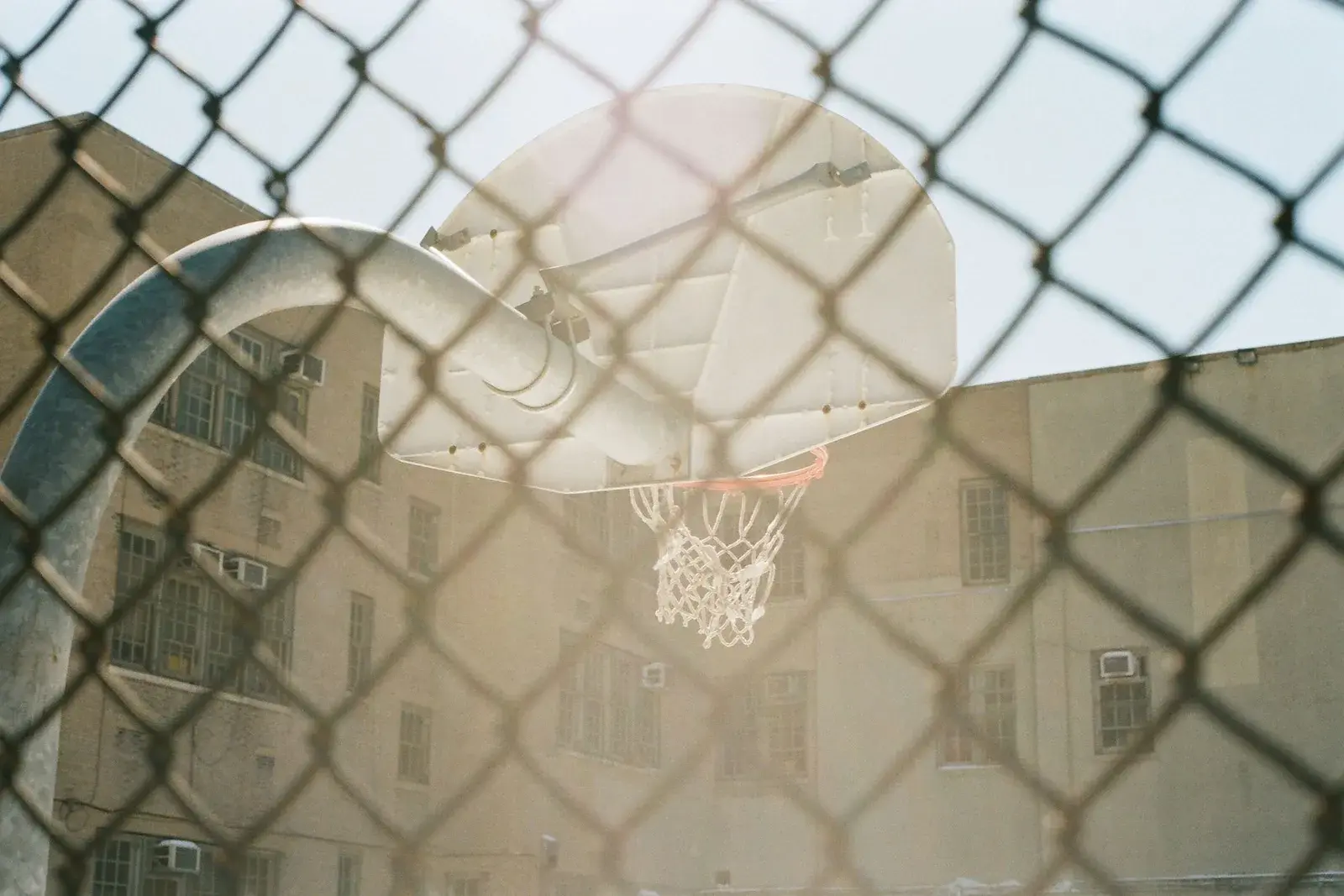
Basketball hoop seen through a chain-link fence, with buildings in the backgroundBrandon Nickerson (Pexels) · licence Pexels
#cinéma#above the rim#death row#bande originale