The legacy
Greatest Hits (1998) and Changes: The Mainstream Gateway
By Selim Rochat · 9 July 2026 · 4 min read
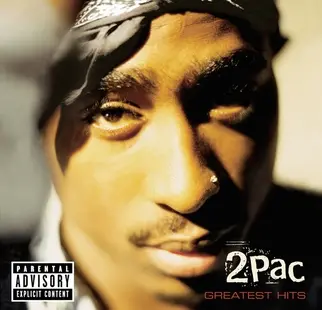
Let me open with a confession that will annoy the purists: like half the Europeans of my generation, my relationship with Tupac was shaped by a best-of. In late 1998, Greatest Hits was spinning in every teenager’s bedroom in French-speaking Switzerland, burned, copied, lent out, scratched. Twenty-five tracks across two CDs, an entire career compressed into a bit over two hours. There is plenty of bad to be said about compilations, and I’ll say some of it below. But denying what this record did for the transmission of the work would be dishonest.
A commercial object, let’s own that
Greatest Hits came out in November 1998 on Amaru, Death Row and Interscope, with Jive in the loop. That list of labels tells you, all by itself, what negotiations it took to gather the Interscope and Death Row catalogues and the unreleased material controlled by Afeni Shakur onto a single object. Commercially, the result outstripped anything rap had ever seen in the format: the compilation would be certified diamond in the United States, making it one of the best-selling best-ofs in the history of the genre, by any artist.
The contents sweep the whole trajectory: the incendiary early tracks of 2Pacalypse Now, the introspection of Me Against the World, the massive hits of All Eyez on Me, a detour through Makaveli. Plus four unreleased tracks, and that’s where the record stops being a mere product.
Changes, the song that changed everything in Europe
Among those four are God Bless the Dead, a reworked version of Troublesome, Unconditional Love, and above all Changes. That one deserves a pause, because its story is fascinating. The song was recorded in 1992, during the era of sessions that also fed R U Still Down?. It’s built on a sample of The Way It Is by Bruce Hornsby and the Range, that 1986 piano ballad everyone knows without being able to name. The track sat in the vault for six years, then came out as a single in late 1998, two years after its author’s death.
And Europe caught fire. Changes climbed the charts across the entire continent. It became the Tupac song your aunt knows, the one you still hear on mainstream radio. An indictment of persistent racism, poverty and police brutality, carried by a piano loop of luminous sadness: the song condenses into four and a half minutes what Tupac had spent his career documenting. That a track left off the albums released in his lifetime became his biggest posthumous hit says a great deal, both about the depth of his archives and about the randomness of how careers unfold.
Unconditional Love deserves better than its supporting-role status too. Written in the final period, the song explores loyalty and love without conditions with a gentleness that cuts against the public image of the Death Row era. It’s one of the most touching posthumous discoveries, and it’s too often forgotten in the long shadow of Changes.
What compilations flatten
Now, the honest debate. A compilation lies by construction. It places the militant Tupac of 1991 next to the Death Row soldier of 1996 as if they were the same man at the same moment, it erases contexts, it turns albums conceived as journeys into a playlist of peaks. Hearing Dear Mama outside of Me Against the World means hearing the song without the night that surrounds it. And the track selection, inevitably, favors the singles: whole stretches of the work, notably the Thug Life period and the depths of Strictly 4 My…, are reduced to scraps.
With Tupac, the flattening does more damage than it would elsewhere, because his contradictions are the heart of the matter. The man who wrote Keep Ya Head Up and the man who wrote Hit ‘Em Up coexist, and that vertigo is what makes the work great. The compilation smooths that vertigo into a mere variety of registers. I develop this further in my article on his influence: reducing Tupac to his hits means missing what he actually left behind.
A map, not a destination
So what do you do with this double CD? Use it for what it is: a map. Greatest Hits is an excellent orientation tool, the best there is for spotting, in two listens, which territories speak to you. The 1993 track grabs you more than the 1996 hit? Head for the original album, in full, in order. That’s exactly the method I lay out in where to start with Tupac. And if the map makes you want to own the record, my vinyl guide explains which pressings to aim for and which counterfeits to spot.
What I refuse is the compilation as a final destination, the idea that with Greatest Hits you’ve “covered it.” You’ve covered nothing. You’ve flown over a continent. But I keep a real tenderness for this imperfect object: without it, millions of European listeners, including the teenager I was, might never have set foot on that continent at all. A map that makes you want to travel is already something. For the rest of the posthumous catalogue, and to find out where the journey goes wrong, my guide to the posthumous albums takes over from here.
#compilation#Changes#1998#discographie